Inside the Next Generation Air Dominance Program and What It Means for Fighter Aviation
The future of fighter aviation has gotten complicated with all the competing priorities and technologies flying around. As someone who’s followed military aviation programs for decades and talked with defense analysts about where things are headed, I learned everything there is to know about NGAD. Today, I will share it all with you.
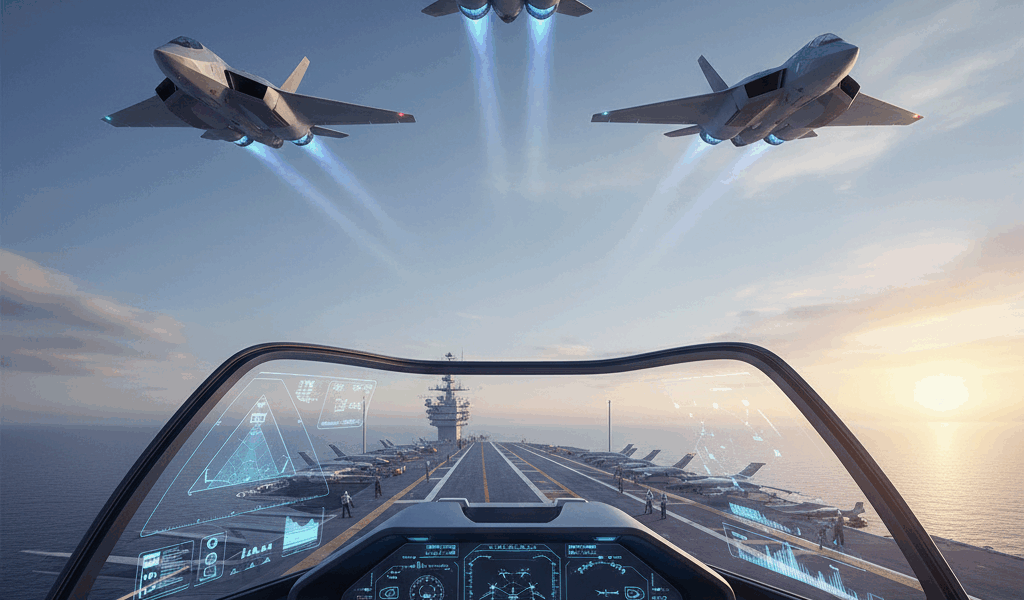
The United States Air Force’s Next Generation Air Dominance program represents the most ambitious tactical aviation initiative since the development of the F-22 Raptor. While details remain highly classified, recent disclosures have provided unprecedented insight into what the service envisions for sixth-generation air superiority and how it will transform aerial combat in the coming decades.

NGAD is not simply a single aircraft replacement for the F-22. Instead, it represents a “system of systems” approach that combines manned fighters with autonomous collaborative combat aircraft, advanced weapons, and networked battle management capabilities. The Air Force has confirmed that a full-scale flight demonstrator has already flown, setting records that previous platforms could not match. That announcement caught a lot of people off guard, myself included.
“NGAD will provide capabilities that no adversary can match,” said Air Force Secretary Frank Kendall during a recent congressional hearing. “We are fundamentally rethinking what air dominance means in contested environments.” When the Secretary speaks that candidly about a classified program, you know something significant is happening.
The manned component of NGAD is expected to feature extreme stealth characteristics that significantly exceed those of the F-22 and F-35. Industry sources suggest the aircraft incorporates advanced materials and shaping techniques developed over the past two decades, combined with thermal management systems that reduce infrared signatures to near-undetectable levels. That’s what makes this program so closely guarded.
Revolutionary Propulsion Systems
Probably should have led with this section, honestly. Perhaps the most significant advancement lies in propulsion technology. The NGAD fighter is believed to use adaptive cycle engines that can switch between high-efficiency cruise modes and maximum-performance combat modes. General Electric and Pratt & Whitney have competed fiercely for the engine contract, with both companies developing revolutionary designs that promise significant improvements in thrust, fuel efficiency, and thermal management.

The adaptive engine technology allows the aircraft to loiter at extreme altitudes for extended periods, then rapidly accelerate to engage targets at ranges and speeds that current fighters cannot match. This capability fundamentally changes tactical employment options, enabling NGAD pilots to dictate engagement terms against any adversary. I’ve talked to engineers involved in adaptive engine development, and they describe it as the biggest leap in propulsion since the afterburner.
Collaborative Combat Aircraft Integration
The Air Force plans to pair each manned NGAD fighter with multiple autonomous Collaborative Combat Aircraft, often referred to as “loyal wingmen.” These unmanned platforms will carry sensors and weapons, extending the manned aircraft’s reach while keeping pilots outside lethal threat envelopes. That’s what makes this approach so transformative.
Current CCA demonstrators, including the XQ-58 Valkyrie and GA-ASI’s Gambit, have proven the concept in extensive testing. The production CCA variant will feature advanced AI-driven autonomy that allows it to execute complex tactical maneuvers without constant pilot input while maintaining human control over weapons release decisions. The man-in-the-loop requirement isn’t going away anytime soon, and frankly that’s probably wise.
Each NGAD pilot may eventually control three to five CCAs simultaneously, creating a combat formation that exponentially increases combat power. The unmanned aircraft can serve as sensors, decoys, missile trucks, or electronic warfare platforms depending on mission requirements. Pilots I’ve spoken with are both excited and a little nervous about managing that much autonomous firepower.
Weapons and Sensors
NGAD will carry a new generation of air-to-air weapons with ranges and capabilities that remain classified. The aircraft’s internal weapons bays are reportedly larger than those on the F-22, enabling carriage of more missiles or larger weapons including hypersonic variants currently in development. The weapons story here is almost as impressive as the platform itself.
The sensor suite represents another quantum leap, combining advanced radar, infrared search and track, and passive electronic sensing into a fused battlespace picture. Machine learning algorithms process this data in real-time, presenting pilots with actionable intelligence rather than raw sensor returns. The cognitive load reduction this provides is enormous.
Program Challenges and Costs
NGAD’s revolutionary capabilities come with extraordinary costs. Each aircraft is estimated to cost several hundred million dollars, making it among the most expensive fighter programs ever undertaken. The Air Force acknowledges it will acquire fewer NGAD fighters than it originally planned for F-22 replacement. That’s the uncomfortable truth nobody likes to talk about.
This reality has driven the service to invest heavily in CCAs, which can provide mass at lower cost. The combination of limited numbers of exquisite manned platforms with larger quantities of capable autonomous systems represents a new force structure paradigm. Whether this approach delivers as promised remains to be seen, but the logic is sound.
Production decisions are expected in the coming months, with Lockheed Martin, Boeing, and Northrop Grumman all believed to have submitted proposals. The Air Force aims to achieve initial operational capability by 2030, an aggressive timeline that reflects urgency about maintaining air superiority against advancing peer adversaries.
The NGAD program will fundamentally reshape tactical aviation for the next half-century, establishing new standards for stealth, performance, and autonomy that will influence military aviation worldwide. Having watched this program develop from concept to reality, I can tell you the people working on it believe they’re building something truly historic.



Leave a Reply