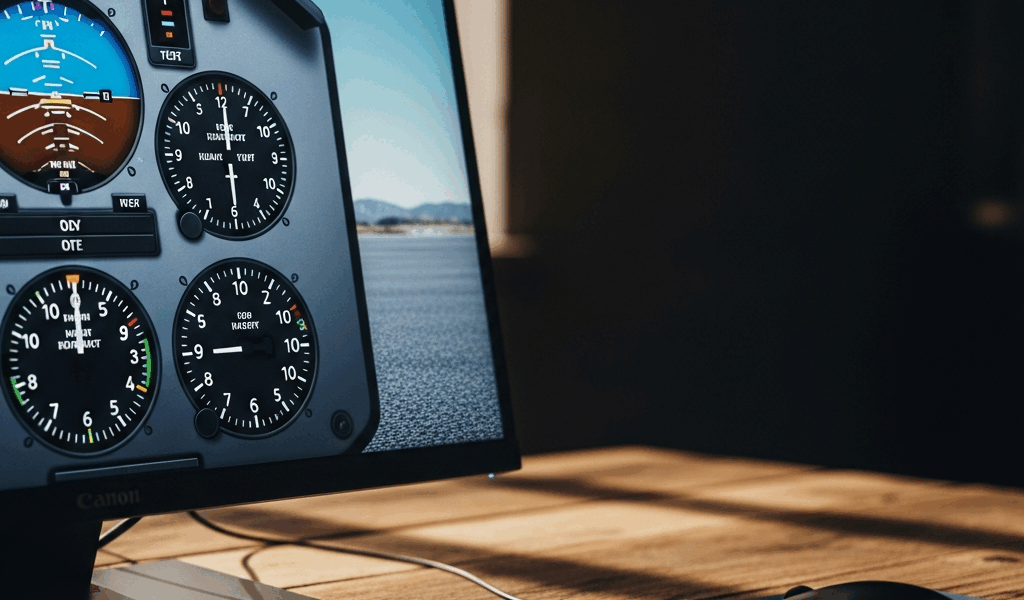
What the TBAS Actually Tests
Army aviation selection has gotten complicated with all the conflicting prep advice flying around. As someone who has spent serious time inside the TBAS preparation process, I learned everything there is to know about what this test actually measures — and what most candidates completely miss. Today, I will share it all with you.
But what is the TBAS? In essence, it’s the Test of Basic Aviation Skills, administered by HumRRO — the U.S. Army’s Human Resources Research Organization. But it’s much more than that. The Army built it from scratch because the standard ASVAB doesn’t touch what helicopter pilots actually need: the ability to track moving objects in real time, absorb two information streams at once, and orient yourself inside three-dimensional space without freezing up. That’s what makes the TBAS endearing to us aviation selection nerds — it measures things you genuinely cannot fake your way through.
Unlike the SIFT, which comes later if you advance, the TBAS zeroes in on raw psychomotor and cognitive ability. No aviation knowledge questions. No medical fitness checks. Four categories define it: psychomotor control (stick-and-rudder response), spatial ability (mentally rotating 3D objects), dichotic listening (splitting attention across two simultaneous audio feeds), and divided attention (juggling tasks without dropping anything). Composite scores run 1 through 9. Five is roughly average. Most candidates cluster right there.
Breaking Down Each TBAS Subtest
Tracking Task — The Stick Control Measure
This is where things get real. You sit in front of a screen — usually running on a standard government-issue workstation — grip a joystick (Thrustmaster T-Flight style, for most test sites), and watch a target dot wander around a crosshair. Keep your cursor on it. Simple concept. Brutal execution.
The dot doesn’t move in patterns you’ve seen before. Your eyes catch movement, your brain translates that into hand correction, your hand overshoots, you correct again — all of it happening in fractions of a second. Helicopter pilots do this exact thing during hovering and precision approaches, which is precisely why the Army cares about it. A weak tracking score signals that your hands won’t respond naturally to aircraft control inputs. That’s a hard problem to overlook.
Most candidates underestimate how specific this skill actually is. You can’t practice “being coordinated” and expect it to transfer. You need to practice this exact motion with this exact interface, burning the neuromuscular pathway in through sheer repetition — dozens of sessions, not three.
Dichotic Listening — The Dual-Audio Component
Headphones go on. Two separate spoken messages play at the same time — one per ear. While you’re still tracking that cursor, you also need to catch specific target words or phonetic patterns from one channel while the other one tries to pull your focus away.
This replicates the cockpit almost perfectly. Radio chatter, warning tones, your own internal task load — helicopter pilots live inside noise-dense environments where filtering irrelevant information isn’t optional, it’s survival. The tricky part is that you can’t fully block the “wrong” ear. Unexpected warnings can come from either channel. It’s sustained selective attention, not a simple on/off switch.
Spatial Orientation and 3D Rotation
You’ll see objects — block shapes or aircraft symbols — rendered in 3D perspective, then rotated to a new position. Pick the answer that matches the correct post-rotation orientation. Sounds manageable until you’re doing it under time pressure on your seventh problem in a row.
Helicopters operate in three dimensions constantly — relative to terrain, obstacles, and other aircraft — and you can’t always trust your instruments. Poor spatial reasoning means you struggle with terrain flight and traffic avoidance. The Army connects this to real-world outcomes, not abstract testing theory.
Situational Awareness Elements
The subtests don’t stay separate for long. While tracking and listening, the interface shifts — the target dot changes color, audio directions rotate, the rules change. Notice it. Adapt. Don’t lose ground on your baseline performance in the process.
This mirrors actual flying almost exactly. Primary task: control the aircraft. Secondary: monitor systems, respond to ATC. Tertiary: watch for threats. All of it at once, none of it optional.
How Your TBAS Score Affects Selection
The TBAS score feeds directly into your SIFT composite and your overall WOFT or OCS aviation packet evaluation. It’s not a pass/fail gate — it’s a percentile rank competing against thousands of other candidates. That distinction matters more than most people realize going in.
Probably should have opened with this section, honestly.
Score in the 1st or 2nd percentile on psychomotor? You’re going to have a hard time recovering, even with a stellar ASVAB and glowing recommendation letters. Psychomotor ability resists improvement in a way that knowledge-based skills don’t. The neuromuscular foundation is either there or it isn’t — and building it from scratch takes real time.
A low spatial score is recoverable through deliberate practice. Dichotic listening improves with exposure — usually four to six weeks of consistent drills. But tracking? That requires hundreds of hours of building automaticity, not dozens. The Army weights it accordingly.
If your first attempt comes back weak, retesting is allowed — but you need a real 6-12 month training cycle between attempts. Don’t make my mistake of assuming a few extra weeks of prep changes the outcome. It doesn’t. This isn’t a knowledge test you can cram for.
How to Actually Prepare for the TBAS
Psychomotor Training
So, without further ado, let’s dive in. Get a consumer-grade flight simulator — X-Plane 12 runs about $60, and Microsoft Flight Simulator 2024 is available on Game Pass for roughly $17/month. Both work fine. Forget about learning realistic aviation procedures for now. Instead, run 30-45 minute sessions focused entirely on hover tasks: pick a helicopter, find a point on the ground, keep the aircraft stationary above it for 10 minutes using only stick inputs.
The joystick matters here. A Thrustmaster T-Flight Hotas One — around $80 at most retailers — replicates the resistance and response curve of actual flight controls far better than a keyboard or gamepad ever will. Practice with real resistance, not digital abstraction. I’m apparently a Thrustmaster person, and it works for me while a standard USB gamepad never felt remotely close.
Beyond sims, the free web-based “Cursor Tracking Challenge” replicates the TBAS tracking task almost exactly. Twenty minutes daily, eight to twelve weeks out from your test date. That’s the minimum effective dose.
Spatial Reasoning Tools
While you won’t need expensive software, you will need a handful of reliable free tools. Search app stores for “3D Rotation” training apps — several solid free options exist. Official military prep sites also carry free spatial reasoning drills built specifically around ASVAB and TBAS formats. Fifteen minutes daily, emphasizing speed and accuracy together — the actual test is timed, and accuracy alone won’t cut it.
Divided Attention and Listening
Download any free metronome app — set it to 60 BPM. While it taps, read complex text aloud. FAA flight training manuals work perfectly for this. Then try counting backwards from 100 by threes while the metronome runs in the background. Uncomfortable? Good. That discomfort is the skill being built.
For the audio component specifically, search YouTube for “dichotic listening task” or “shadowing task exercises.” Ten minutes per session, three to four times weekly. That’s enough volume to see meaningful improvement inside six weeks — at least if you’re actually pushing your attention rather than just going through motions.
Common TBAS Mistakes and How to Avoid Them
Frustrated by watching otherwise qualified candidates flame out on a test they barely prepared for, I started tracking the patterns. The same mistakes show up constantly.
First: treating the TBAS as one test instead of four separate skills. Candidates spend two weeks reading about it, decide that familiarity equals competence, then bomb the psychomotor section — because they never once touched a joystick before sitting down at the test station. That’s not bad luck. That’s a preparation gap.
Second: ignoring dichotic listening entirely. “I’m good at multitasking” is not a training plan. Your ears and brain need structured exposure to simultaneous audio streams under cognitive load. Winging it produces predictable results.
Third: going in without any interface familiarity. Cursor sensitivity, screen resolution, click response latency — these vary by test site hardware. If your site offers a practice version, use it. One session with the actual interface saves you from burning mental energy on basic orientation during the real attempt.
This new approach to TBAS prep — treating it as four distinct training tracks running in parallel — has gradually evolved into the framework serious WOFT candidates know and use today. If your score comes back lower than expected, resist the urge to blame testing conditions. The TBAS measures trainable skills. Underperformance means the training wasn’t long enough, specific enough, or high enough in volume. The first attempt tells you where your actual baseline is. The next 6-12 months tell you what you’re willing to do about it.



Leave a Reply