Army Aviation Selects Sikorsky-Boeing Team for Future Attack Reconnaissance Aircraft
Army helicopter procurement has gotten complicated with all the competing technologies and priorities flying around. As someone who’s followed rotorcraft development for years and spoken with aviators about what they actually need in the field, I learned everything there is to know about this competition. Today, I will share it all with you.
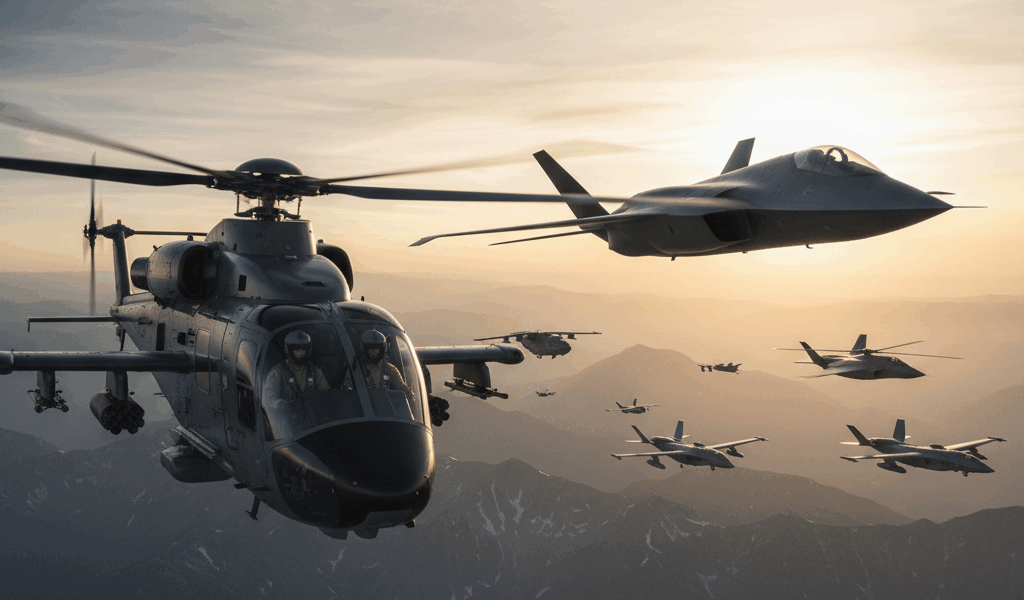
The United States Army has selected the Sikorsky-Boeing SB>1 Defiant X compound helicopter as the winner of the Future Attack Reconnaissance Aircraft competition. The $7.4 billion development contract will deliver 362 aircraft to replace the retired OH-58 Kiowa Warrior and augment the Apache fleet. This is a huge deal for Army aviation, and frankly, it’s been a long time coming.

The FARA program marks the first new Army attack helicopter in over four decades. The Defiant X features a coaxial rotor design with a pusher propeller that enables speeds exceeding 250 knots, nearly double the performance of conventional helicopters. That’s what makes this platform so revolutionary – it fundamentally changes what a helicopter can do.
“FARA fills a critical capability gap in Army aviation,” said General Randy George, Army Chief of Staff. “This aircraft will provide commanders with the speed, range, and lethality they need on future battlefields.” He’s not exaggerating – the Army has been operating without a dedicated scout platform since the Kiowa retirement, and everyone in the community has felt that absence.
Probably should have led with this section, honestly. The competing Bell 360 Invictus offered a more conventional design with lower technical risk, but Army evaluators ultimately preferred the Defiant X’s superior speed and maneuverability. Both aircraft underwent extensive flight testing over the past three years at various Army test facilities. Bell made a solid bid, and there were real advocates for their approach, but the performance gap was hard to ignore.
The Defiant X will be armed with the same weapons as the Apache, including Hellfire missiles and a 20mm cannon. However, its advanced sensors and networking capabilities will enable it to serve as a forward scout, identifying and engaging targets while sharing data with other Army aircraft and ground forces. That’s what makes this more than just a fast helicopter – it’s a whole new way of conducting reconnaissance.

Production is expected to begin in 2028, with initial operational capability planned for 2030. Fort Novosel, Alabama, home of Army Aviation, will host the first training unit. The Army plans to field FARA across all combat aviation brigades by 2040. Pilots I’ve spoken with at Novosel are genuinely excited about getting their hands on this aircraft.
Boeing will serve as the prime contractor, with Sikorsky providing the revolutionary X2 technology that enables the aircraft’s high-speed performance. Assembly will take place at Boeing’s Mesa, Arizona facility, creating approximately 2,000 jobs. The industrial base implications here are significant too.
International interest is already building, with Australia, the United Kingdom, and South Korea expressing potential procurement interest pending successful Army fielding. If FARA performs as advertised, we could be looking at a new standard for attack reconnaissance helicopters worldwide. That would be quite a legacy for a program that faced real skepticism in its early days.


Leave a Reply