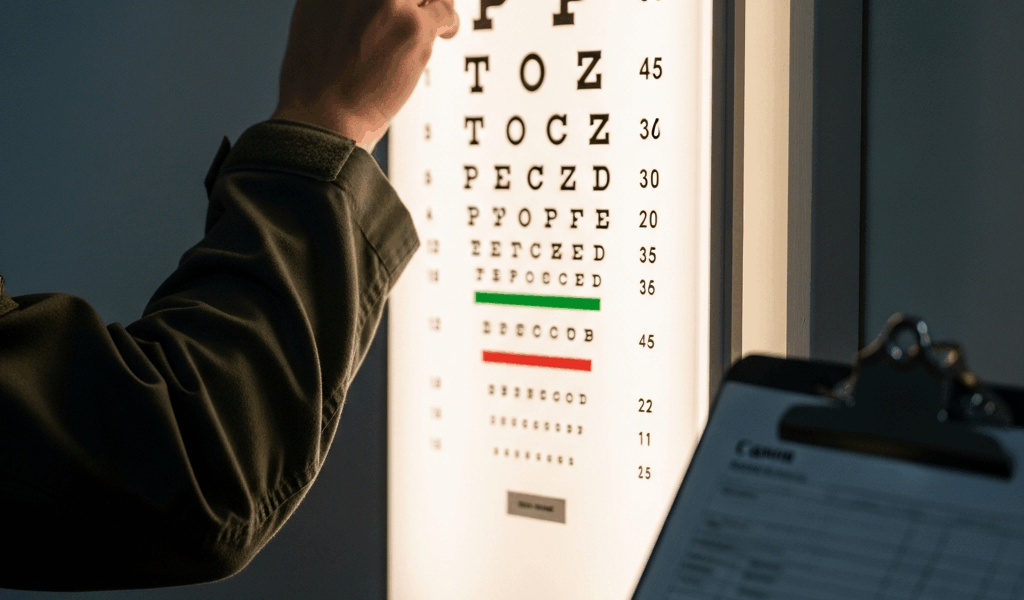
Vision Standards Overview Across Service Branches
I spent two years in military recruiting offices, and the single most common question from pilot applicants wasn’t about flight school difficulty or career prospects—it was whether their eyesight disqualified them. The frustrating answer? It depends entirely on which branch you’re trying to join.
The Air Force operates under the strictest vision standards in the U.S. military. The Navy sits somewhere in the middle. The Army, by contrast, remains the most permissive. This isn’t bureaucratic inconsistency—each branch designed its medical requirements around actual cockpit demands and aircraft complexity.
Standards also splinter by pilot track. An Air Force fixed-wing pilot faces different refractive limits than an Army rotary-wing aviator. A Naval aviator preparing for carrier operations gets scrutinized differently than a Marine Corps pilot. You can’t assume one standard applies across the board, and that mistake costs applicants thousands in wasted medical evaluations.
What matters most: uncorrected vision, correctable vision limits, color vision classification, and depth perception thresholds. Each branch weights these differently. Understanding your branch’s specific cutoffs before spending money on MEPS evaluations saves time and prevents the crushing disappointment of discovering you’re ineligible partway through the process.
Air Force Pilot Vision Requirements — Uncorrected and Corrected
The Air Force Pilot Candidate Selection Method (PCSM) medical standards demand 20/50 or better uncorrected in each eye. That’s sharper than Army requirements and significantly stricter than what the Navy permits for some aviator tracks.
For corrected vision, you’re looking at 20/20 in each eye post-correction, with a combined refractive error limit of -8.00 diopters to +8.00 diopters. Astigmatism maxes out at 3.00 diopters. In practical terms: if you wear -7.50 glasses and have 1.50 diopters of astigmatism, you’re within limits. If you’re a -9.00 with your current prescription, you’re disqualified—even with perfect corrected acuity.
Color vision gets tested via the Ishihara test at MEPS. Air Force pilots cannot be color blind in the red-green spectrum. You’ll also take a Farnsworth-Lantern test if initial screening flags concerns. There’s no waiver path here—fail color vision, and your pilot dreams end for the Air Force.
Depth perception must be 20 seconds of arc or better, tested with a simple stereoscopic device. Probably should have opened with this section, honestly—depth perception sounds minor until you realize it’s non-waiverable and catches people who didn’t know to worry about it.
LASIK and PRK are approved, but you must have had the surgery completed at least one year before applying, with stable refraction for six months prior. Current refractive limits still apply post-surgery—you can’t expect the Air Force to accept 20/30 corrected vision just because you had refractive surgery.
Army Rotary Wing and Fixed Wing Vision Standards
Army aviation splits into two tracks: warrant officer aviators (primarily rotary wing) and Aviation Officers (fixed wing and command tracks). Vision standards differ slightly between them.
Warrant Officer Aviators can present with 20/70 uncorrected vision in each eye. That’s a massive advantage over Air Force standards. Corrected, you need 20/20 in each eye, but your refractive error ceiling is -8.00 to +8.00 diopters with up to 3.00 diopters of astigmatism—identical to Air Force limits on refractive range, but the uncorrected starting point is far more forgiving.
Aviation Officers (those pursuing fixed-wing tracks or command positions) face tighter requirements: 20/40 uncorrected, 20/20 corrected, same refractive limits. The distinction matters because warrant officers fly predominantly rotary-wing (Blackhawks, Apaches, Chinooks)—where depth perception and peripheral vision from the cockpit context matter more than raw uncorrected acuity.
Color vision testing uses the Ishihara plates. If you fail initial screening, the Army may use the Farnsworth-Lantern or even request civilian ophthalmology testing. The Army is occasionally more flexible here than the Air Force—some applicants with “moderate” red-green deficiencies have received waivers for rotary-wing slots, particularly if their corrected vision is exceptional. This flexibility doesn’t extend to fixed-wing officer tracks.
LASIK and PRK require one-year completion pre-application, same as Air Force. Depth perception: 40 seconds of arc or better for warrant officers, 20 seconds for officers.
Navy and Marine Corps Pilot Vision Cutoffs
Naval aviators must meet 20/40 uncorrected minimum in the eye with better vision; the other eye requires at least 20/70. This asymmetry surprises most candidates. Corrected acuity ceiling is 20/20 in each eye.
Refractive error limits: -8.00 to +8.00 diopters with 3.00 diopters astigmatism maximum. Functionally identical to Air Force and Army officer requirements, despite the looser uncorrected standard.
Naval Flight Officers (NFO) get similar standards but occasionally see slight flexibility on color vision testing—the Navy has been known to work with candidates who present marginal color plates but otherwise excel in selection metrics. This is unofficial and shouldn’t be counted on, but Navy selection boards have more discretion here than Air Force boards do.
Marine Corps pilots must hit 20/40 uncorrected in the better eye, 20/70 in the worse eye, mirroring Navy requirements. Corrected vision: 20/20 each eye. Refractive limits identical to Navy and Air Force standards.
LASIK/PRK: one-year post-procedure, six-month stable refraction. Depth perception: 20 seconds of arc for Naval Aviators, 40 seconds for NFOs. The Navy and Marines don’t significantly differentiate between rotary and fixed-wing candidates on vision thresholds—both tracks use the same baseline.
What Disqualifies You Before Waiver Consideration
Certain eye conditions trigger automatic disqualification across all branches, regardless of rank or pilot track. These hard stops exist because they predict degradation in flight that no waiver authority can override.
Retinitis pigmentosa disqualifies you everywhere. Keratoconus (progressive corneal thinning) is an automatic no. Recent retinal detachment or history of multiple detachments: disqualified. Progressive myopia beyond stable limits: gone. Any condition involving active retinal bleeding, advanced diabetic retinopathy, or angle-closure glaucoma ends your application immediately.
Certain refractive surgeries also create hard stops. Radial keratotomy (older surgery, rarely performed now) is permanently disqualifying for military pilots across all branches, even decades post-procedure. The corneal scarring pattern is unpredictable long-term.
The Air Force holds stricter standards on what constitutes a “hard stop.” Navy and Army are marginally more flexible on conditions like previous corneal abrasions or mild dry eye if current testing shows stability. But retinitis pigmentosa, keratoconus, and progressive myopia aren’t waiverable in any service.
Waiverable conditions include corrected refractive error outside normal limits but within Air Force/Navy/Army-specific thresholds, mild color vision deficiencies (Army primarily), and past refractive surgery if protocol requirements are met. Waiver approval takes months and isn’t guaranteed.
How to Check If You Meet Your Branch’s Standards
Start with a civilian eye exam. Visit an optometrist or ophthalmologist and request your uncorrected vision, corrected vision (both eyes and each eye individually), refractive error measurements in diopters, and color vision testing results. Request these in writing on the provider’s letterhead—MEPS will ask for documentation anyway.
Download your target branch’s official medical form. Air Force uses the 2808-1 (Medical Examination). Army and Navy use variations of the standard medical questionnaire. These forms are available on each branch’s recruitment website or through your military recruiter. Don’t rely on generic PDFs—get the current version.
Cross-reference your civilian exam results against the branch-specific thresholds outlined above. If you’re at the edge (say, 20/50 uncorrected for Air Force), schedule a MEPS pre-screening with your recruiter. Some recruiters can connect you with military optometrists who’ll run preliminary evaluations before official MEPS testing.
MEPS testing uses automated refraction equipment and standardized color vision protocols. The exam takes roughly 30 minutes. Results are documented on your medical file immediately, and your recruiter receives notification within 48 hours whether you’re qualified or flagged for further evaluation.
If you’re disqualified at MEPS, you can request a formal recheck with a different optometrist at another MEPS facility, but you cannot appeal based on civilian exam results alone. Documentation from your civilian provider helps support a waiver request if your branch permits one.



Leave a Reply