“`html
Why Depth Perception Matters for Military Pilots
Depth perception test failures at Military Entrance Processing Stations (MEPS) have gotten complicated with all the confusion flying around—and honestly, it ranks among the top medical disqualifiers candidates face. The standard threshold sits at 40 seconds of arc or better. That’s the visual angle your eyes resolve when judging distance and spatial relationships. As someone who’s reviewed aviation medical standards across three service branches, I learned everything there is to know about why this test carries weight: it directly impacts your ability to land an aircraft, judge closure rates in formation flying, and respond to threats in three-dimensional space.
The Air Force, Navy, and Marine Corps all enforce this requirement, though the Air Force tends to be strictest. The Army and Coast Guard have slightly more flexibility depending on your specific role. Why does this matter so much? Pilots need to perceive depth accurately without instruments during low-visibility approaches, emergency landings, and aerial refueling operations. A gap of even a few seconds of arc can be the difference between a safe landing and an accident.
Here’s the thing nobody mentions: one failed test is not permanent. The depth perception measurement is quantifiable. It can be retested. It can sometimes be appealed. And there are legitimate pathways around it that candidates almost never discover until it’s too late.
Common Reasons Depth Perception Tests Fail
Failing a depth perception test doesn’t mean your eyes are fundamentally broken. I’ve seen dozens of candidates fail on their first attempt and pass on their second with absolutely zero changes to vision correction.
Environmental factors wreck test performance. MEPS testing rooms are often fluorescent-lit, sterile, and stressful—you’ve been sitting in a medical facility for six hours already. Your cortisol is elevated. The examiner might be running behind schedule and moving faster than standard protocol. The Titmus Fly Test or TNO test equipment might have dust on the lenses or improper calibration. MEPS equipment gets checked annually, but not every single week.
Fatigue alone tanks depth perception scores. Testing early in the morning before you’ve eaten, or after a long drive to MEPS absolutely affects your ability to converge your eyes properly on the stereoscopic images. Eye strain from previous testing stations compounds this. If you’ve already done color blindness tests, vision acuity tests, and visual fields testing, your visual system is genuinely fatigued.
Refractive errors complicate things too. Uncorrected or incorrectly corrected astigmatism can degrade depth perception even if your acuity is 20/20. Strabismus—eye misalignment—sometimes goes undetected at initial screening but shows up under the specific demands of depth perception testing. Presbyopia affects adults over 40 differently than younger candidates.
Many candidates don’t understand the instructions clearly during testing. The examiner might rush through the explanation. You might not ask for clarification because you’re intimidated by the medical setting. If you’re not holding your head at precisely the right distance or angle during testing, your results shift. The test is sensitive to position—probably should have opened with this section, honestly.
Medication side effects, dehydration, and even your caffeine intake affect accommodation and convergence—the twin functions that depth perception depends on. None of this means you can’t fly. It means that particular moment, under those particular conditions, you didn’t test well.
Step-by-Step Appeal Process After Failure
First action: Get the actual numerical result from MEPS before you leave that day. Do not rely on memory. Request it in writing. The score matters. If you scored 35 seconds of arc and the threshold is 40, you’re closer than someone scoring 20. The exact deficit changes your appeal strategy.
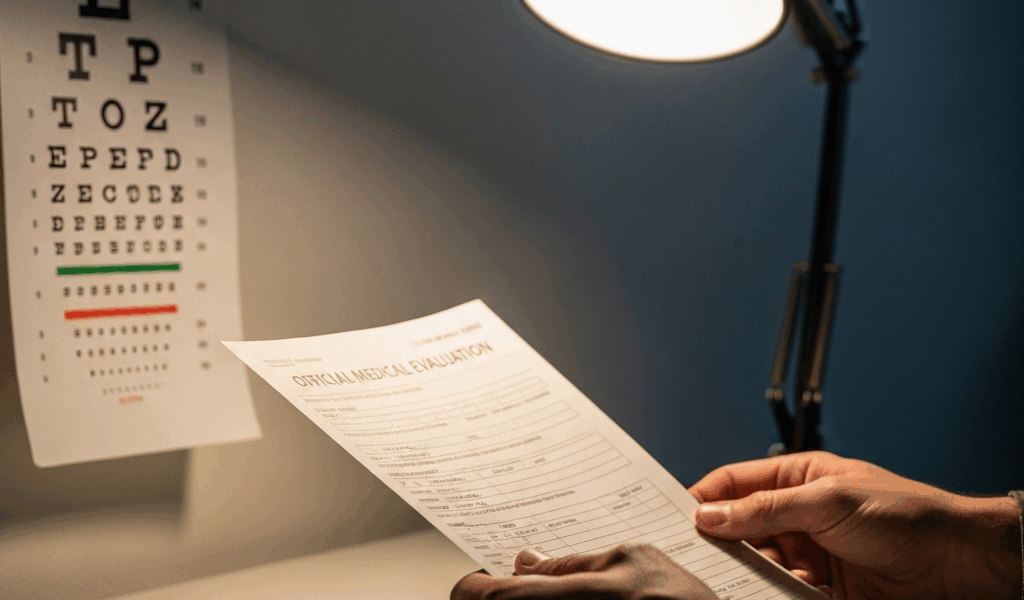
Read your medical examination documentation carefully. The examiner records which test was used (Titmus Fly, TNO, or occasionally the Random Dot E test), environmental conditions, and notes. If anything looks factually wrong—”candidate appeared drowsy” when you weren’t, or any “equipment malfunctioned” statement you don’t recall—document that discrepancy immediately.
Request a retest through MEPS before initiating any formal appeal. Most medical guidance counselors will allow one retest at the same MEPS location at no additional cost. This must happen within 60 days of your first failure for best standing. Space the retest at least 48 hours after the initial test—your visual system actually does need recovery time. Come hydrated. Eat breakfast. Get proper sleep the night before. Wear your glasses or contacts if you use them. Test early in the morning when you’re sharpest.
If you fail the retest, then the appeal process begins in earnest. Contact your recruiting office and specifically ask for the “medical waiver package” or “medical appeal process” documentation. Different branches use different terminology, but the pathway exists.
For Air Force candidates, you’ll submit formal documentation to the Medical Standards Officer (MSO) at your regional Air Force Medical Examination Center (AFMEC). Navy and Marine Corps routes go through the Naval Aerospace Medical Institute (NAMI) or your regional Flight Surgeon’s office. Army pilots coordinate through their aviation medical examiner. Coast Guard has the Coast Guard Medical Examination Center. Each branch operates slightly differently.
Gather supporting documentation: civilian ophthalmology or optometry records showing your baseline vision health, medication list (to rule out interaction effects), sleep quality records from the nights before testing, and a written statement explaining your understanding of the test requirements and your confidence in your actual depth perception ability. That last part matters more than candidates think—the Flight Surgeon is evaluating your judgment and honesty, not just the test score.
Submit everything together in one package. Don’t dribble documentation in over weeks. Medical reviewers work through applications in batches. A complete package from day one moves faster.
Medical Waiver and Alternative Assessment Routes
MEPS can grant a medical waiver for marginal failures—typically anything within 5 seconds of arc of the threshold. The Flight Surgeon reviews the overall clinical picture: your other vision metrics (acuity, color vision, visual fields, ocular health), your medical history, and the circumstances of your failure. They’re looking for evidence that your depth perception is actually adequate for flight duties, even if the test result says otherwise.
Some marginal failures are approved with the simple notation “waived by Flight Surgeon” in your medical file. You never know you had a waiver. You just move forward. Other borderline cases require additional documentation—a civilian eye exam by a military-approved provider confirming adequate depth perception through clinical evaluation rather than formal testing.
Branch differences matter significantly here. The Navy and Marine Corps accept civilian eye exams from ophthalmologists or optometrists on their approved provider list more readily than the Air Force does. The Air Force prefers to see retesting at an AFMEC-affiliated location. The Army falls somewhere in the middle—often will accept a civilian retest if the provider is credentialed and the exam uses military-standard equipment.
Contact your regional Flight Surgeon’s office before spending money on civilian testing. Ask specifically: “Can a civilian eye exam with results for depth perception submitted to your office satisfy the requirement if the initial MEPS test was borderline?” Get a written response if possible. Some civilian ophthalmologists work regularly with military candidates and know exactly what documentation format the military requires.
Alternative assessment options exist beyond the standard MEPS tests. The Randot Stereoacuity Test and the Random Dot E test measure depth perception differently than the Titmus Fly Test. If your first failure used the Titmus, requesting a retest with a different method sometimes yields different results—the visual demands shift slightly. The TNO test, for example, relies less on accommodative effort and more on pure stereoscopic vision, which might favor you if accommodation was your weak point.
Timeline and Next Steps If Appeal Fails
Realistic timeline: 4 to 8 weeks from submitting your appeal package to receiving a final decision. The Flight Surgeon doesn’t work in isolation. Your package routes through multiple reviewers. Medical boards convene monthly or quarterly depending on the branch. Don’t expect answers in days.
If your waiver appeal is denied, you typically have the right to reapply at the next officer candidate selection board or enlisted selection board your service offers. The denial doesn’t blackball you permanently. However, you’d need to demonstrate changed circumstances—improved test results, new clinical evidence, or additional time passing to show the failure was situational rather than physiological.
If retesting and appeals genuinely aren’t working, alternative pilot tracks exist. You could pursue non-pilot aircrew positions: Combat Systems Officer (Navy), Weapons Officer (Air Force), Enlisted Flight Officer roles, or Intelligence Officer tracks that involve aviation support without requiring the same depth perception standards. These careers still involve flying and still lead to advancement, just through a different cockpit position.
The ground truth: depth perception failures are surmountable for most candidates. The appeal process works because the test itself is imperfect, and the military understands that. Document everything. Retest when possible. Submit complete packages. Don’t make my mistake—assuming one bad test defines your aviation future.
“`



Leave a Reply