What the Military Color Vision Test Actually Measures
The Ishihara plate test is what you’ll face when the military screens your color vision. I spent weeks preparing for my own medical evaluation, and I’ll be honest — I didn’t actually understand what the test was checking for until I failed it and had to dig into the documentation myself.
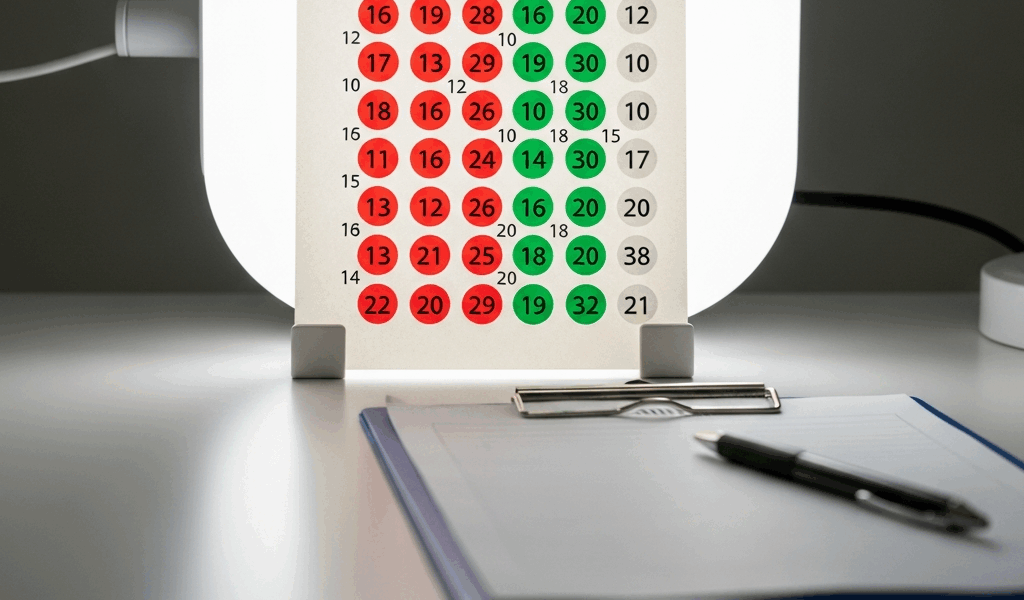
The military uses Ishihara plates because they’re fast, portable, and standardized across all branches. A series of circular plates contains dots in different colors and patterns. If you can see the number embedded in the dots, your color vision passes. The test specifically targets red-green color blindness, which affects roughly 8% of men and 0.5% of women.
Here’s what trips up most candidates: failing the Ishihara doesn’t mean you’re colorblind in everyday life. It means your photoreceptors don’t meet the military’s operational threshold. The Air Force, Navy, and Army each set different minimum standards — the Air Force is strictest for pilots, while the Army occasionally permits waivers for certain roles.
Red-green color blindness comes in two flavors. Protanopia means you lack red-sensing cones; deuteranopia means you lack green-sensing cones. Both show up the same way on Ishihara plates, but they’re neurologically distinct. There’s also color weakness, where you see color but with reduced discrimination. This matters because some branches differentiate between clinical color blindness and color deficiency when considering waivers.
The critical misconception: failure doesn’t equal disqualification. It means your file moves to a different evaluation track. I learned this the hard way when my recruiter initially made it sound like my entire pilot dream was finished.
Immediate Steps After Test Failure
You get your results within 24 to 72 hours, usually in writing from the Military Entrance Processing Station (MEPS) doctor. Your recruiter will notify you before the official paperwork arrives. This is when panic often kicks in.
First: don’t argue with the technician about the result on test day. The Ishihara is binary — you either identify the numbers or you don’t. Disputing it in the moment wastes goodwill and won’t change anything. I made this mistake, and it made my follow-up retest request awkward.
Second: request a retest immediately. Different branches handle this differently. The Air Force typically allows one retest after a 30-day cooling-off period. The Navy permits retesting but with tighter windows. The Army sometimes allows multiple attempts. Write a formal email to your MEPS medical officer and recruiter stating you want to pursue a retest. Include the date of your original test and your confirmation number from your initial evaluation.
Third: notify your recruiter in writing that you’re requesting a retest and understand the timeline. Don’t let this sit in verbal agreement territory. Email creates a paper trail, which matters when processing medical waivers later. Send it to your recruiter and request acknowledgment.
What not to do: don’t attempt home remedies, eye drops, or color blindness correction glasses before your retest. These won’t change your Ishihara result, and if discovered, they’ll destroy your credibility with medical personnel. Don’t skip the cooling-off period — retesting too soon shows the military you’re not taking the evaluation seriously.
The cooling-off period exists because the Ishihara occasionally produces false positives due to fatigue, stress, or poor lighting. Waiting 30 days gives you a legitimate chance at a clean retest under optimal conditions.
Retest Options and What Changes Between Attempts
Your second attempt will use a fresh set of Ishihara plates — same test protocol, different cards. The technician will administer it under the same lighting and distance standards. Conditions matter more than you’d expect. Fluorescent lighting creates false results more often than natural light.
Some branches supplement the Ishihara with alternative tests if you fail the initial screening. The Farnsworth-Munsell 100 Hue Test measures color discrimination across the full spectrum, not just red-green. The Anomaloscope is the gold standard but expensive and rarely used in military settings. The Lantern Test — like the Army Color Vision Tester or Optec — simulates how you’d perform identifying colored navigation lights. That’s relevant for pilots making decisions at night.
Here’s the reality: if you pass the retest, you’re cleared. If you fail again, your file automatically escalates to medical review. The Air Force sends your case to AFMES (Air Force Medical Evaluation), the Navy to BUMED (Bureau of Medicine and Surgery), and the Army to its Aviation Center of Excellence. This isn’t the end — it’s where waivers get seriously considered.
Timeline varies by branch. Air Force typically takes 60 to 90 days for waiver adjudication. Navy takes longer, sometimes 120 days. Army processes fastest, 45 to 60 days. These are estimates; backlog affects actual timelines. During this period, you’re in administrative limbo — not disqualified, but not cleared either.
One detail that catches candidates off guard: retesting costs nothing, but if you request expedited processing or additional testing beyond standard protocols, you may pay out of pocket. Standard retest is military-covered.
Color Vision Waiver Path for Pilots
A waiver isn’t approval of your condition. It’s official documentation that you failed the standard test but the service branch determined your specific deficiency doesn’t disqualify you operationally. The distinction matters because waivers are branch-specific — an Air Force waiver won’t transfer if you switch to the Navy.
The Air Force approves roughly 15 to 20% of color vision waiver requests for pilot candidates, based on recent data from AFMES. The Navy approves fewer, around 10%. The Army, training more rotary-wing pilots, has slightly higher approval rates — 20 to 25%. These aren’t guaranteed. They’re historical baselines.
What gets reviewed during waiver consideration: your actual Ishihara scores (how many plates you missed), the alternative test results (if completed), your medical history for other eye conditions, your flight hour experience (if applicable), and sometimes your career timeline. The board wants evidence that your color vision deficiency won’t impact safety-critical decisions in the cockpit.
Documentation required includes your original MEPS report, any supplemental test results, a letter from your recruiter or commander supporting your pilot qualification, and sometimes a civilian optometrist’s assessment of your color vision. You may need to pay for this civilian exam yourself — budget $150 to $300.
Probably should have opened with this section, honestly: getting a waiver approved depends less on your test scores and more on how you present the case. I’ve seen candidates denied with better raw scores because their supporting documentation was weak. I’ve seen others approved because they framed their application with specific examples of color-dependent tasks they’ve already completed successfully.
The waiver packet goes to a board of flight surgeons and senior pilots. They review it in closed session. You get a yes-or-no answer, rarely with detailed feedback on why. If denied, you can request reconsideration once, but changing the outcome requires new evidence — updated testing, letters from commanding officers, proof of flight time under color-dependent conditions.
Alternative Pilot Roles If Waiver Denied
Denial stings. But “pilot” encompasses multiple career fields in military aviation, and some don’t require standard color vision clearance.
Sensor operators — RPA pilots operating drones and surveillance systems — sometimes have more lenient color vision standards than manned aircraft pilots. The Air Force considers these separately because the operational context differs. You’re not landing an aircraft or visually identifying targets in poor light the same way. Not all branches have this option, but the Space Force and Air Force Reserve use sensor operators with varied medical clearance pathways. This is actively worth exploring with your recruiter before accepting a denial.
Combat systems officers or weapons officers in the Navy and Air Force focus on systems management and targeting rather than aircraft control. Color vision isn’t the limiting factor for these tracks. The entry requirements differ — sometimes you need engineering degrees or specific test scores — but if you’re flexible about your exact role, this path can work.
Enlisted aircrew positions (loadmaster, flight engineer, crew chief) typically have lower color vision standards than officers. An Air Force loadmaster might fail the pilot Ishihara but pass enlisted aviation standards. The pay and prestige differ, but the flying time is real, and you’re building aviation credentials that could support a later transition.
Air traffic control is often overlooked. If you fail the pilot color vision test, ATC might still clear you. The standards are different — you’re identifying radar symbols and light indicators, not relying on natural color discrimination. Salary is competitive, the job is genuinely interesting, and it’s a legitimate pathway if pilot-specific roles close.
Warrant officer aviation tracks in the Army provide a different route entirely. Some warrant officer candidates face relaxed color vision requirements compared to commissioned officer pilots. The Army’s needs for helicopter pilots sometimes outweigh strict medical standardization. This isn’t guaranteed, but it’s explicitly worth asking your Army recruiter.
The trade-off: these roles don’t carry the same prestige or earning potential as being a commissioned pilot. But they’re not fallback plans — they’re legitimate aviation careers where you’re still flying, building experience, and maintaining options for future transitions. Some people start as sensor operators, rack up flight hours, then reapply for pilot slots with documented operational experience. It’s not the straightforward path, but it works.
Before accepting “no” entirely, exhaust every option within your current branch. Then research parallel tracks in other branches. The military doesn’t always communicate these alternatives clearly, which leaves candidates thinking color vision failure is a complete endpoint. It’s usually just a detour.



Leave a Reply