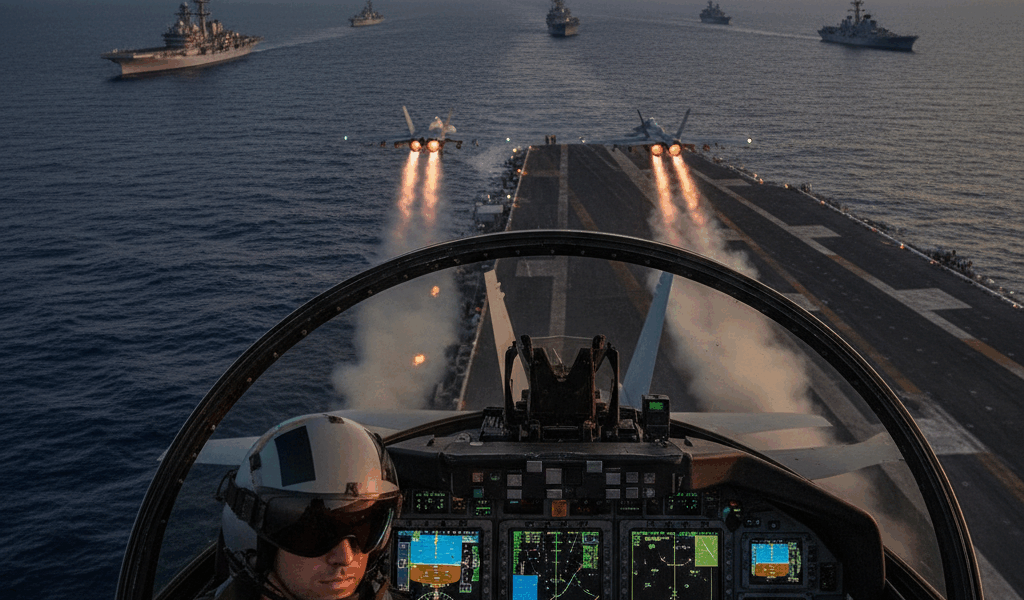
Carrier Aviation Enters a New Era as the Navy Prepares for Distributed Maritime Operations
Naval warfare has gotten complicated with all the new threats and doctrines flying around. As someone who’s spent years following carrier operations and talking to aviators about what’s changing on the flight deck, I learned everything there is to know about how the Navy is reimagining its most powerful asset. Today, I will share it all with you.
The United States Navy is undertaking its most significant transformation of carrier aviation doctrine since the introduction of jet aircraft seven decades ago. Distributed Maritime Operations, which most people just call DMO, fundamentally reimagines how aircraft carriers and their air wings will fight in an era of long-range precision weapons and contested electromagnetic environments.

For generations, the carrier strike group operated as a concentrated force, with escorts and aircraft providing layered defense while strike aircraft projected power ashore. This approach exploited American advantages in maritime domain awareness and precision strike while presenting adversaries with a daunting defensive challenge. It worked beautifully for decades.
But here’s the thing – today’s threat environment has changed the calculus entirely. Peer adversaries have developed long-range anti-ship missiles, advanced submarines, and sophisticated intelligence, surveillance, and reconnaissance capabilities that can locate and target carrier formations at unprecedented ranges. The traditional carrier strike group operating concept must evolve or face growing risk in contested waters.
Distributed Maritime Operations Concept
Probably should have led with this section, honestly. DMO envisions a Navy that fights as a distributed force, with ships and aircraft spread across vast ocean areas while maintaining the networked connectivity to concentrate effects at decisive points. Rather than massing physical platforms, the Navy will mass weapons and information across extended battlespace.
For carrier aviation, this transformation has profound implications that touch everything from aircraft design to pilot training. Air wings must operate at greater ranges from their ships, striking targets while their carriers remain outside adversary weapons engagement zones. Aircraft must survive and operate in environments where communications may be degraded and support limited.

“The era of the carrier operating with impunity in any water on Earth is ending,” acknowledged Admiral Samuel Paparo, Commander of U.S. Pacific Fleet. “We are adapting our tactics, training, and force structure to maintain the decisive advantage carrier aviation provides.” That’s about as candid as you’ll hear a four-star get about the challenges ahead.
Extended Range Strike
The MQ-25 Stingray unmanned tanker addresses carrier aviation’s range challenge directly. By refueling strike aircraft in flight, the Stingray can extend the combat radius of F/A-18E/F Super Hornets and F-35C Lightning II fighters by hundreds of miles, allowing carriers to project power while remaining farther from shore-based threats. That’s what makes this platform game-changing.
The Navy is also developing longer-range weapons that multiply aircraft effectiveness. The AGM-158C Long Range Anti-Ship Missile and its successors will enable strikes against surface targets at distances that exceed current capabilities, while new variants of the Joint Air-to-Surface Standoff Missile family provide similar reach against land targets.
These weapons require aircraft with sensors and data links capable of targeting at extended ranges. The F-35C’s sensor suite and networking capabilities make it the centerpiece of future air wing strike packages, able to find, fix, and engage targets that legacy aircraft could not independently acquire. I’ve talked to pilots who describe the F-35’s situational awareness as almost unfair compared to fourth-gen jets.
Air Wing Composition Changes
The carrier air wing is undergoing compositional changes that reflect DMO requirements. The addition of MQ-25 detachments is just the beginning, and what comes next will reshape the flight deck in ways we’re only starting to understand. The Navy is studying unmanned strike and reconnaissance platforms that could augment manned aircraft, extending air wing reach while managing risk to pilots.
The Collaborative Combat Aircraft concepts being developed for the Air Force have direct naval applications. Ship-launched autonomous aircraft could precede manned strike packages, identifying threats and saturating defenses before pilots enter the battlespace. These platforms could also provide persistent surveillance that allows carriers to maintain awareness of adversary activities across extended areas.
Electronic warfare capabilities are receiving significant investment, and for good reason. The EA-18G Growler fleet is being upgraded with new jamming pods and techniques designed for peer adversary communications and radar systems. Future unmanned platforms may assume portions of the electronic warfare mission, freeing Growlers for other tasks. That’s what makes the Growler community so critical right now.
Training and Tactics Evolution
Naval aviators are training for scenarios their predecessors never imagined. Exercises now emphasize operations with degraded communications, forcing pilots to execute pre-briefed missions when real-time coordination with carrier battle managers becomes impossible. It’s a return to mission-type orders in some ways, trusting pilots to execute the commander’s intent without constant oversight.
Night and adverse weather operations receive renewed emphasis, exploiting conditions that complicate adversary targeting while testing pilot skills in demanding environments. The days of fair-weather carrier operations are giving way to all-conditions proficiency requirements. Pilots tell me the workload increase is substantial but necessary.
Joint integration has become critical for success. Navy and Air Force aircraft will fight together in any major conflict, requiring interoperability in communications, tactics, and procedures. The F-35’s common data link provides a foundation, but human and organizational integration requires constant exercise and relationship-building between the services.
Challenges and Uncertainties
Transformation on this scale presents significant challenges that shouldn’t be glossed over. The fleet must maintain readiness for today’s missions while developing capabilities for future fights. Budgetary pressures force difficult tradeoffs between procurement of new platforms and sustainment of existing forces.
Personnel policies must evolve to recruit and retain the technically skilled sailors and aviators DMO demands. Operating sophisticated unmanned systems, maintaining complex weapons, and conducting distributed operations in contested environments require expertise that competes with civilian sector opportunities. The talent war is real, and the Navy knows it.
Despite challenges, the Navy is committed to evolving carrier aviation for the distributed maritime future. The aircraft carrier remains the most flexible and powerful military instrument available to national leadership. Ensuring that capability endures requires continuous adaptation to emerging threats and technologies.
The carrier air wing of 2030 will look different from today’s, and the one flying in 2040 different still. What will remain constant is the American commitment to projecting power from the sea, maintaining maritime superiority that underpins global security and commerce. Distributed Maritime Operations represents not an abandonment of carrier aviation but its evolution for a new era of competition. The aviators I’ve spoken with are cautiously optimistic – they know change is hard, but they also know standing still isn’t an option.

Leave a Reply