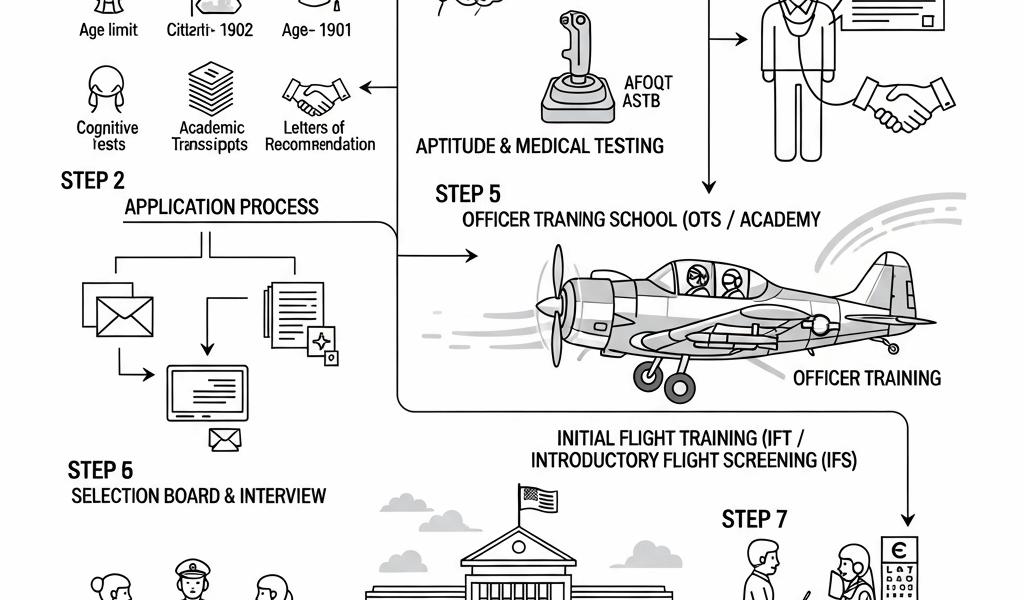
How to Become a Military Pilot in 2026 — Step by Step
Becoming a military pilot has gotten complicated with all the outdated, half-true information flying around online. As someone who spent close to eight months digging into this process — talking to active duty aviators, sitting through career briefings, and reading every AFPC and BUPERS document I could track down — I learned everything there is to know about what it actually takes. And here’s the thing: most websites skip the hard part. Everyone says “get a degree and pass a flight physical.” Nobody tells you the specific test scores that get you screened in or out, or what life looks like after you pin on wings. This article does that. Branch by branch, with real milestones and honest timelines, so you can plan the next two to five years around something more solid than a vague roadmap.
Requirements Before You Apply
This is where most people get eliminated before they ever write an application. The requirements are specific — a few of them are absolute. No exceptions, no waivers for most. Get familiar with these now, not after you’ve already spent two years in an ROTC program wondering why nobody warned you.
Age Limits by Branch
Each branch sets its own maximum age for entering pilot training. The cutoffs are tighter than people expect. As of 2026:
- Air Force: Must start Undergraduate Pilot Training (UPT) before age 33. Commission before 28 if you want a realistic shot at selection.
- Navy / Marine Corps: Must begin flight training before age 27 for unrestricted aviation. Some lateral entry programs push this to 29 with a waiver.
- Army: The most flexible option — Warrant Officer candidates can be up to 33 at the time of application. Commissioned officer pilot slots run similar constraints to the Air Force.
- Coast Guard: Age 27 cutoff for Aviation Selection Test Battery eligibility, with limited waiver authority.
The Army Warrant Officer route deserves its own mention. It’s the only branch where you can become a military pilot — specifically a helicopter pilot — without a four-year degree, though a degree genuinely strengthens your packet. If you’re 30 years old, no degree in hand, and you want to fly, the Army Warrant Officer pipeline is probably the most realistic door open to you right now.
Vision Standards
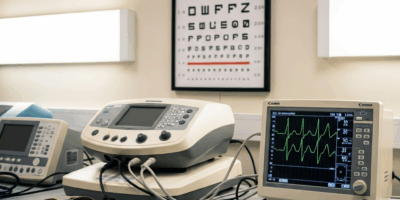
Vision requirements tripped up several people I talked to who had been planning on military aviation for years. The standards shift depending on aircraft type and branch — but here’s the practical summary:
- Distant visual acuity must be correctable to 20/20 in each eye.
- The Air Force allows PRK and LASIK — but not LASIK for fighter aircraft. PRK only, and you must wait 12 months post-surgery before your flight physical.
- The Navy accepts LASIK for unrestricted aviation with a 6-month stabilization period.
- Color vision deficiencies are disqualifying in most cases, though some branches allow a waiver for non-fighter aircraft.
Book your eye exam with a civilian ophthalmologist before you commit to an application timeline. Get the actual measurements — not just the 20/20 notation. Military flight surgeons want spherical equivalent values, cylinder readings, axial length measurements. Knowing your numbers early saves months of uncertainty. Don’t make my mistake of assuming the basic notation tells you everything you need to know.
Test Scores — AFOQT and ASTB
But what are the AFOQT and ASTB-E? In essence, they’re cognitive and aptitude tests that gate aviation selection. But they’re much more than that — they’re the filters that determine whether you’re even in the conversation for a flying assignment.
For the Air Force, the relevant AFOQT subtests are Pilot and Navigator/Technical. Competitive scores for a rated slot sit at 90+ on Pilot and 70+ on Navigator. You can score a 75 on Pilot and technically be eligible — but looking at selection boards from 2023 and 2024, the mean Pilot score among selected candidates ran above 88. Scoring below 70 on Pilot closes the door entirely.
The ASTB-E — used by the Navy and Marine Corps — produces a Military Flight Aptitude Rating (MFAR). A score of 6 or above is generally competitive for fixed-wing aircraft. Below 4 is disqualifying. The test also produces an Officer Aptitude Rating (OAR) used separately for OCS selection. You get three lifetime attempts at the ASTB-E, with mandatory waiting periods between them — 90 days between attempts one and two, 180 days between two and three. Do not take it cold. The Barron’s ASTB study guide, roughly $18–22 at most retailers, and the free practice materials at military.com’s test prep section are legitimate starting points.
Degree Requirements
A four-year bachelor’s degree from an accredited institution is required for commissioned officer pilot routes in every branch. The field matters less than people assume — engineering helps with technical subtests, but history majors fly F-35s. GPA matters for competitive selections, though. Anything below 3.0 is a liability at a selection board. That’s just the reality.
Officer Commissioning Routes
Probably should have opened with this section, honestly. The route you pick to commission shapes everything — your timeline, your debt load, your selection odds, and even which aircraft types you’re likely to fly. Three main paths exist: Service Academy, ROTC, and Officer Training School or Officer Candidate School.
Service Academy
The Air Force Academy in Colorado Springs, the Naval Academy in Annapolis, and West Point for Army aviation are the most selective — and the most resource-rich. Acceptance rates hover around 10–12% for qualified applicants. The process starts junior year of high school with congressional nominations. You graduate with a commission and zero tuition debt. The catch: four years of college plus a five-year minimum active duty commitment before you ever submit a pilot application packet. Academy graduates still compete for rated slots. A diploma from Colorado Springs doesn’t guarantee you a cockpit.
ROTC
Reserve Officers’ Training Corps programs run at roughly 1,000 colleges and universities nationwide. Air Force ROTC scholarships cover up to $18,000 per year in tuition. Four years of college, concurrent military training, and you commission as a second lieutenant. For a scholarship, apply by November of your senior year of high school for a four-year award — or apply within the program for two- and three-year options.
Fascinated by aviation from the time I was reading Jane’s Fighting Aircraft books as a kid, I talked to multiple ROTC cadets who said the biggest surprise was how early the rated board competition happens — you’re competing for pilot slots during junior year of college, before you’ve even commissioned. AFOQT scores, GPA, physical fitness test scores, and commander ranking all go into the board packet. Getting a pilot slot through ROTC isn’t automatic. In recent years, roughly 30–40% of ROTC graduates who applied for rated slots actually received them.
OTS / OCS
Officer Training School for the Air Force and Officer Candidate School for the Navy, Army, and Marines are 8–13 week programs that commission college graduates who weren’t in ROTC or the academies. This is the route for people who finished a civilian degree and then decided they wanted to fly. The Air Force typically selects pilots from OTS at rates similar to ROTC — around 25–35% of applicants who specifically request rated assignments. Timeline from application to commission through OTS runs roughly 9–18 months, depending on the fiscal year and how many pilot slots the Air Force programmed for that year’s force structure plan.
Undergraduate Pilot Training Timeline
This is the section most career websites skip entirely — or summarize in two sentences. UPT is long, demanding, and structured. Total pipeline from assignment to wings runs 12–18 months, depending on your track and whether weather or aircraft availability throws any delays into the schedule.
IFS — Introductory Flight Screening
Before UPT, Air Force pilot candidates complete Introductory Flight Screening at Pueblo Memorial Airport in Colorado — a detail that surprises most people who assumed it happened on a military installation. IFS runs approximately 25 hours of flight time in a Diamond DA-20, a light civilian trainer. Ground school academics and simulator work run alongside the flying. The purpose is to screen out candidates who lack basic aptitude before the Air Force invests a full year of resources. Wash-out rate at IFS sits around 10–15%. The whole program takes about three weeks.
Pass IFS and you get a report date to a UPT base — currently Vance AFB in Enid, Oklahoma; Laughlin AFB in Del Rio, Texas; Columbus AFB in Mississippi; or Sheppard AFB in Wichita Falls, Texas for the Euro-NATO Joint Jet Pilot Training program.
T-6 Texan II Phase — Primary Training
The T-6A Texan II is a single-engine turboprop trainer made by Beechcraft — now Textron Aviation. This phase runs approximately six months and covers aerobatics, instrument flying, formation flying, and low-level navigation. It is genuinely hard. Academics run parallel to the flying: systems knowledge, weather theory, emergency procedures. You will spend evenings and weekends drilling emergency procedure boldface items until you can recite them half-asleep. Multiple students wash back each class — meaning they restart the phase. Wash-out from the T-6 phase runs approximately 10–20% depending on the class.
Track Select
Midway through UPT — roughly six months in — the class goes through track select. This determines whether you continue toward fighters and bombers, mobility and tanker aircraft, or helicopters and turboprops. Track select runs on class ranking (academic plus flying grades combined), Air Force needs at that specific moment, and your own stated preferences. Top graduates in a fighter-heavy year get fighters. It doesn’t always work out the way candidates want. A T-6 instructor at Vance I talked to had a personal rule of thumb he shared: if you want fighters, you need to be in the top 20% of your class and the Air Force needs to be buying fighters that year. Both conditions have to be true simultaneously.
Advanced Training — T-38 or T-1
Fighter and bomber track students move to the T-38C Talon — a supersonic jet trainer — at the same base. Mobility and tanker track students move to the T-1A Jayhawk, a modified Beechjet 400A, for multi-engine instrument training. Helicopter track students head to Fort Novosel in Alabama for rotary wing training. Advanced training takes another five to six months. Wings get awarded at the end — a formal ceremony where your family pins the silver wings on your uniform. That’s what makes the whole pipeline endearing to us aviation obsessives: it’s grueling and procedural right up until the moment it becomes genuinely personal.
Total elapsed time from IFS check-in to wings: approximately 14–16 months on the standard track.
Your First Assignment and Service Commitment
Wings in hand, the Air Force tells you where you’re going. The assignment process runs through the Air Force Personnel Center at Randolph AFB in San Antonio. Here’s what actually happens — and what you can and cannot control.
The 10-Year Active Duty Service Commitment
Receiving your wings triggers a 10-year Active Duty Service Commitment. This runs from the date you complete your Formal Training Unit — the aircraft-specific school after UPT where you learn the actual jet you’ll fly operationally. For a fighter pilot completing the F-16 FTU at Luke AFB, that 10-year clock starts at Luke graduation, not at wings. The FTU typically adds another 6–9 months to your training pipeline.
Ten years is a long time to commit to an institution at age 25. Think about it seriously. Several pilots I spoke with said they hadn’t fully processed what a decade of service actually meant until they were three years in — promotions behind them, moves done, and the exit ramp still years away.
Aircraft Assignment Process
After track select in UPT, you complete a dream sheet — a prioritized list of aircraft and bases you want. AFPC matches assignment needs against class ranking and stated preferences. The assignment you receive isn’t negotiable in most cases. What you can influence: your class rank determines how early you pick during assignment night, a formal event at the end of UPT where the class gathers, assignments get revealed, and there is — apparently without exception — beer afterward.
Compassionate reassignments and humanitarian assignments exist for documented hardship cases. Volunteering for specific overseas assignments or career broadening positions can create follow-on assignment consideration. These levers are real — but limited. The Air Force’s needs drive the process, and your preferences come second. Go in knowing that, and the whole thing is a lot less disorienting when your dream sheet doesn’t come back the way you wrote it.
The path to becoming a military pilot in 2026 is structured, competitive, and long — roughly four years of college plus 18 months of training at minimum before you’re flying operationally. Every step has a hard requirement attached to it. Start with the physical and test score qualifications, pick your commissioning route based on where you are in your education timeline, and plan your UPT years knowing track select is the pivot point that determines everything after it.

Leave a Reply