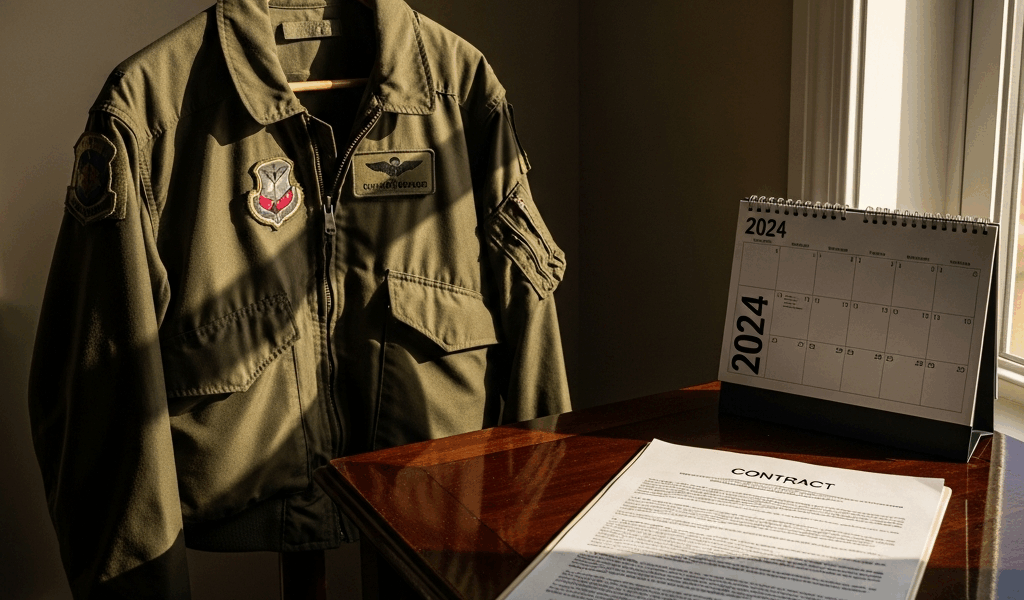
Service Commitment by Branch — The Full Breakdown
Military pilot service commitments have gotten complicated with all the misinformation flying around. I started researching this expecting one clean number — maybe a footnote about exceptions. What I found instead was a patchwork of federal minimums, branch-specific extensions, and career-altering consequences that nobody explains clearly before you sign anything.
But what is a service commitment, exactly? In essence, it’s the legally binding period you owe the military after earning your wings. But it’s much more than that — it’s the years stacked between you and whatever comes next, whether that’s an airline cockpit, a civilian career, or something else entirely.
Federal law sets absolute minimums: 8 years for fixed-wing jet pilots, 6 years for other aircraft. Actual commitments? Considerably longer. And they vary wildly depending on which branch you join.
Here’s what you actually owe:
| Branch | Service Commitment | Clock Starts | Notes |
|---|---|---|---|
| Air Force | 10 years | Upon earning wings | Actively considering reduction; contentious among pilots |
| Navy | 8 years | Upon earning wings | Can extend for aviation bonuses |
| Marine Corps | 8 years | Upon earning wings | Same as Navy; shared training pipeline |
| Army | 6 years | Upon earning wings | Extended from 4 years in 2023; pilots not happy |
| Coast Guard | 4 years | Upon earning wings | Shortest commitment in DoD aviation |
| Air National Guard | Varies (typically 6-8) | Upon earning wings | State-dependent; often more flexible |
| Air Force Reserve | 8 years | Upon earning wings | Shorter than active-duty Air Force |
Air Force — The 10-Year Standard
Ten years. That’s what the Air Force wants from you the day you pin on your wings at undergraduate pilot training — and it’s not negotiable. Doesn’t matter if you’re flying F-16s or wide-body transports. The clock starts at graduation and runs a full decade.
That’s what makes the Air Force commitment stand out even among its own pilots — two years beyond the federal minimum for jet aviators, defended fiercely by leadership for years. Cracks are forming in that position, though. Pilot retention has become a genuine crisis. In 2023, roughly 7 to 8 percent of Air Force pilots walked at their earliest separation point. That’s not a rounding error when you’re talking about trained combat aviators.
Inside the pilot community, honestly, the 10-year requirement has become a lightning rod. Young officers entering training know they’re signing away a full decade. The alternative — flying commercially — pays more and starts sooner. A pilot in their late twenties watching civilian peers bank six-figure salaries runs that math pretty quickly.
Navy and Marine Corps — Eight Years
Naval aviators get a slightly better deal: 8 years after earning wings. Navy pilots, Marine Corps pilots — same number, same training pipeline at Naval Air Station Kingsville and Naval Base Corpus Christi in Texas. That shared pipeline is actually one of the more interesting structural quirks in military aviation.
Eight years hits the federal minimum for fixed-wing naval aviators exactly. No excess, technically. But eight years is eight years — a pilot who starts training at 23 clears that commitment at 31. By then, civilian pilots hired at the same age have already built meaningful seniority at major carriers. That gap compounds over time.
The Navy does offer extensions — usually attached to aviation bonuses ranging from $100,000 to over $400,000 depending on aircraft type and fiscal year. Some pilots see that as a genuine win. Others see it as getting paid to stay longer than they wanted. The calculus is deeply personal, and apparently the answer varies a lot depending on what aircraft you’re flying.
Army — Six Years (But That Changed Recently)
Probably should have opened with this section, honestly, because it illustrates exactly how branch leadership can shift the rules on you mid-stream.
Frustrated by a steady exodus of experienced helicopter pilots leaving for civilian jobs, Army leadership announced in 2023 that the service commitment was jumping from 4 years to 6. The increase landed suddenly on officers already deep into their careers — some of them mid-way through airline interview prep, some of them having made financial and family decisions based on the old timeline.
Don’t make my mistake of assuming these things are locked in when you sign. Six years is the number now. The Army’s stated rationale was hemorrhaging talent to the civilian sector, and extending the commitment was supposed to buy time to improve retention. Whether it actually works is genuinely unclear — what’s clear is that officers who commissioned under the old terms felt blindsided. That kind of institutional trust damage doesn’t disappear quietly.
Coast Guard — The Four-Year Outlier
Four years after earning wings. That’s it. The Coast Guard holds the shortest pilot commitment in all of DoD aviation — and that makes it a popular choice for people treating military service as a structured pathway into the airlines.
Coast Guard helicopter pilots can theoretically exit service far faster than their Navy or Air Force counterparts. Four years is manageable in a way that a decade simply isn’t. You’re not surrendering your thirties to a fixed timeline.
The tradeoff is real, though. The Coast Guard runs a much smaller aviation footprint — fewer slots, fewer aircraft, fewer bases spread across the country. The mission set narrows to search and rescue, law enforcement, and disaster response. Career progression looks different. The civilian transition still happens, just on a smaller scale than what you’d see coming out of a major active-duty branch.
Why Commitments Are Getting Longer
Military aviation has a retention problem — one that’s worsened noticeably over the past five years. Pilot shortages hit readiness. They stretch training timelines. They complicate deployments and eventually land on someone’s desk in Congress as a budget problem that needs solving.
The Army’s 2023 extension is the most visible recent example, but the Air Force has been under pressure to push its 10-year commitment even further. Some senior leaders have floated 12 years. The pilot community opposes it — loudly, in most forums where they’re allowed to be loud. The math is stark: a 12-year Air Force commitment means you can’t seriously pursue an airline career until your mid-thirties, when seniority systems have already assigned you to lower pay scales and less desirable routes for years.
What’s actually driving these extensions?
- Airline hiring frenzy. Regional carriers, major airlines, and international operators are all actively recruiting military pilots — they value the training quality and security clearances. Military aviators are attractive hires. That creates direct, ongoing competition for retention that branch leadership is struggling to match.
- Training timeline. Producing a combat-ready pilot from the day someone enters flight school takes roughly 3 to 4 years. That’s an enormous upfront investment — and the military wants a measurable return on it, counted in years of actual service.
- Experience drain at mid-career. Historically, the most experienced pilots have exited at their first separation eligibility — the captains and majors who know how to lead, train junior aviators, and execute complex missions under pressure. Losing them consistently accelerates a cycle where less-experienced officers get pushed into leadership roles before they’re ready.



Leave a Reply