Why G-Force Exposure Matters in UPT
Military pilot G-force training has gotten complicated with all the misconceptions flying around. It’s not optional, not something you skip if your neck feels tight. As someone who spent three years watching UPT candidates progress through Undergraduate Pilot Training, I learned that the centrifuge determines who flies fighters and who doesn’t. The human body isn’t designed to handle six, seven, or eight times the force of gravity — your aircraft demands it anyway.
Fighter aircraft pull sustained G-loads that would render an untrained pilot unconscious in seconds. An F-16 in a 4G turn feels manageable enough. But sustained 6-8G maneuvers — the combat-realistic scenarios you’ll face in advanced training — require every physiological defense your body can muster. The T-6 Texan II introduces you to moderate G exposure during intermediate training. By the time you reach the T-38 Talon in advanced training, you’re pulling consistent 6G turns during air combat training. That’s what makes the centrifuge endearing to fighter pilots: it’s where you learn to handle what comes next.
G-LOC — loss of consciousness from G-induced pooling of blood away from your brain — kills pilots who haven’t trained for it. In essence, it’s gravity pulling your blood downward, toward your legs and torso. But it’s much more than that. Without active countermeasures, your vision grays out within 2-3 Gs, and you lose consciousness by 4-5G sustained. The centrifuge teaches you to fight that pooling using muscular contraction, breathing technique, and mental preparation. This is survivable. It’s trainable. But it requires respect and preparation.
Pre-Centrifuge Conditioning Exercises
Probably should have opened with this section, honestly. Most candidates arrive at the centrifuge undertrained and pay for it with brutal soreness and diminished performance.
Start with neck isometrics eight to ten weeks before your scheduled centrifuge ride. Your neck muscles absorb enormous stress during high-G maneuvers. Sit upright, place your palm against the side of your head, and push hard without moving your neck. Hold for eight seconds. Do this four times per direction — left, right, forward, backward. Complete three sets daily, five days per week. The soreness you feel after centrifuge rides stems largely from neck overload. Pre-training prevents that entirely.
The L-1 maneuver is your primary anti-G straining technique. Contract your abdominal muscles as hard as you can while simultaneously tensing your leg muscles. Imagine bracing for a punch to the stomach while squeezing a volleyball between your thighs. You’ll perform this during actual G exposure to maintain blood pressure and cerebral perfusion. Practice it daily — at least if you want consistent results. Stand with feet shoulder-width apart and perform maximal abdominal and lower-body isometric contraction for five seconds. Rest ten seconds. Repeat for three sets of eight repetitions. This sounds simple. It’s exhausting, which is exactly the point.
Leg press progressions build the muscular endurance you need. Three times per week, perform weighted leg presses with progressively heavier loads. Weeks one through three: three sets of ten repetitions at bodyweight or light resistance. Weeks four through six: three sets of eight repetitions at 1.5x bodyweight. Weeks seven through nine: three sets of six repetitions at 2x bodyweight. The final two weeks: three sets of five repetitions at 2.5x bodyweight. Your legs are your primary anti-G mechanism during centrifuge exposure — don’t skip this part.
Sustained Valsalva breathing is the final piece. This is deliberate breath-holding combined with abdominal straining. Inhale normally, then close your glottis (the opening in your throat) and strain your abdomen as if you’re trying to expel air against resistance. Hold for four seconds. Release, breathe, repeat. Do this for three sets of ten repetitions, three times per week. The sensation feels unnatural at first. By centrifuge day, it’s automatic.
What Happens During Your First Centrifuge Ride
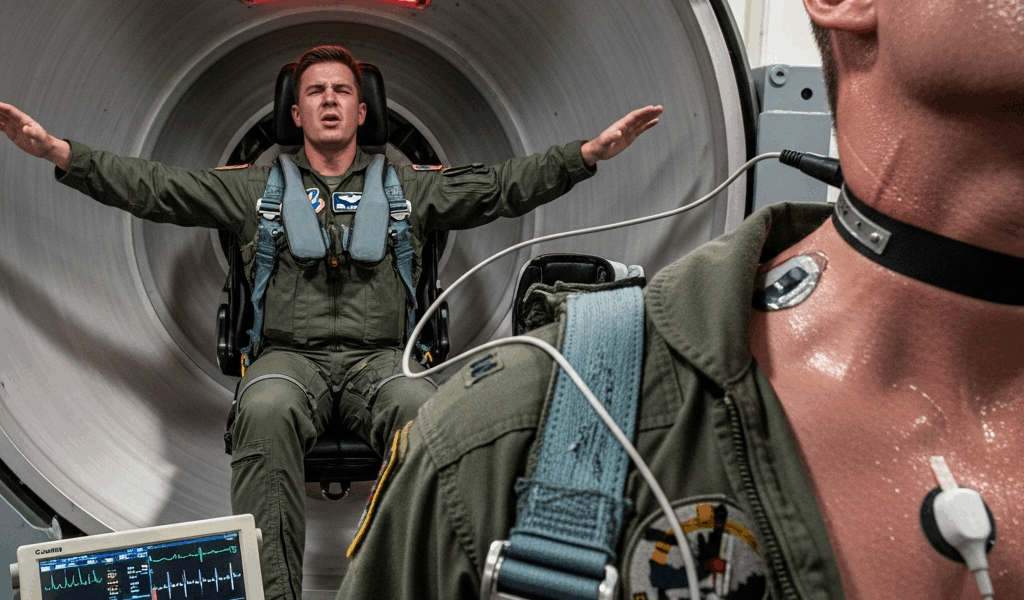
You arrive at the training facility ninety minutes early. The preflight brief covers the sequence, your responsibilities, and emergency procedures. You’ll sit in a gondola — a small sealed cabin attached to a rotating arm. The operator spins you up gradually while monitoring your vital signs and communication. There’s no hiding. Everything is measured and recorded.
Next comes harness fitting. This is precise work. The harness distributes G-load across your torso, legs, and neck. Improper fitting means uneven load distribution and worsened discomfort. A properly fitted harness feels snug against your shoulders, chest, waist, and thighs. You’ll feel pressure, not constriction. Speak up if anything digs or pinches — this is your only chance to correct it.
The in-seat checklist takes fifteen minutes. Head position, arm placement, foot position on rudder pedals. The gondola mimics an aircraft cockpit in miniature. You’re seated upright, facing forward, with instruments and controls in front of you. You’ll perform simple tasks — reading instruments, manipulating switches — at various G-levels to assess your cognitive function under load.
Spin-up begins. You feel the gondola move, then accelerate. Your weight increases gradually. At 2G, you weigh twice what you do normally. It’s noticeable but not alarming. You breathe normally and continue your tasks. Then the operator calls your target G-load. Let’s say six Gs. You begin the L-1 maneuver. Your abdomen contracts hard. Your legs squeeze. You perform Valsalva breathing in rhythm with the centrifuge cycle. The pressure in your chest and head intensifies. Your vision may gray slightly at the periphery. This is normal. The straining keeps blood in your head.
Common fears arrive here. G-LOC feels like your consciousness dimming, like you’re losing the battle. You’re not — you’re experiencing the physiological limits of your current conditioning. Many pilots push harder, strain more intensely, and regain their visual clarity. Others reach a plateau and hold it. Both are acceptable outcomes on ride one. Your job is to strain effectively, breathe rhythmically, and communicate clearly with the operator.
Recovery happens in reverse. The spin rate decreases. Your weight normalizes. You relax your straining. Blood rushes back to your head. Some pilots experience mild nausea here. Others feel disorientation — a brief sense that the floor is tilting or the room is spinning. Your inner ear is adjusting. It passes in seconds. You sit upright, unbuckle, and walk out under your own power.
Common Mistakes Pilots Make Before Centrifuge
Undereating is mistake number one. Arrive hungry or with low blood sugar, and your performance tanks immediately. You need sustained energy for the ride. Eat a substantial breakfast three hours before your scheduled time. Rice, lean protein, and fruit work well. Avoid heavy fats or excessive fiber — you don’t want your stomach competing for blood during G-exposure.
Skipping neck preparation is mistake number two. I’ve watched candidates arrive at centrifuge with zero neck conditioning and spend the next week unable to turn their heads past forty-five degrees. Eight to ten weeks of isometric work prevents this entirely. Don’t rationalize skipping it because you “feel strong.” Neck strength and general fitness are different systems.
Poor breathing technique compounds everything else. Shallow, irregular breathing during the ride means inconsistent straining. Your anti-G effectiveness drops. Your vision grays more aggressively. Practice your breathing rhythm during training. Establish a cadence that matches your straining intensity. Rhythm is everything here.
Overconfidence kills performance on ride one. Some candidates think they’ll power through eight Gs on day one without conditioning. They arrive, spin up to six Gs, and G-LOC within thirty seconds. They’re now exhausted, disoriented, and convinced the centrifuge is harder than it actually is. Show respect to the equipment and yourself. Train properly. Perform honestly.
Recovery and Training Progression
Your neck will hurt. Expect significant soreness for three to five days after your first ride — this is muscular damage from unaccustomed load. Ice for fifteen minutes, four times daily, for the first two days. Take ibuprofen as directed. Gentle neck stretching accelerates recovery. By day six, soreness diminishes markedly.
Most pilots undergo multiple centrifuge rides spread across their training pipeline. Your second ride, six to eight weeks later, feels dramatically easier. Your conditioning carries over. You know the sequence. You understand the sensations. Performance improvement is tangible and immediate.
Mental resilience builds with each exposure. G-LOC becomes less frightening because you’ve experienced it in a controlled, monitored environment. You’ve learned that your body recovers instantly. You’ve proven to yourself that you can function under extraordinary physiological stress.
Across multiple sorties, pilots consistently report improved anti-G straining effectiveness, earlier onset of effective conscious control, and reduced nausea and disorientation during recovery. These aren’t dramatic improvements. They’re incremental gains built on proper conditioning and honest effort.
This is survivable. You’re not alone in this experience. Thousands of pilots have trained through centrifuge rides and emerged fully capable. Your conditioning determines your outcome. Respect the process. Prepare thoroughly. Perform with intention. The results follow naturally.




Leave a Reply