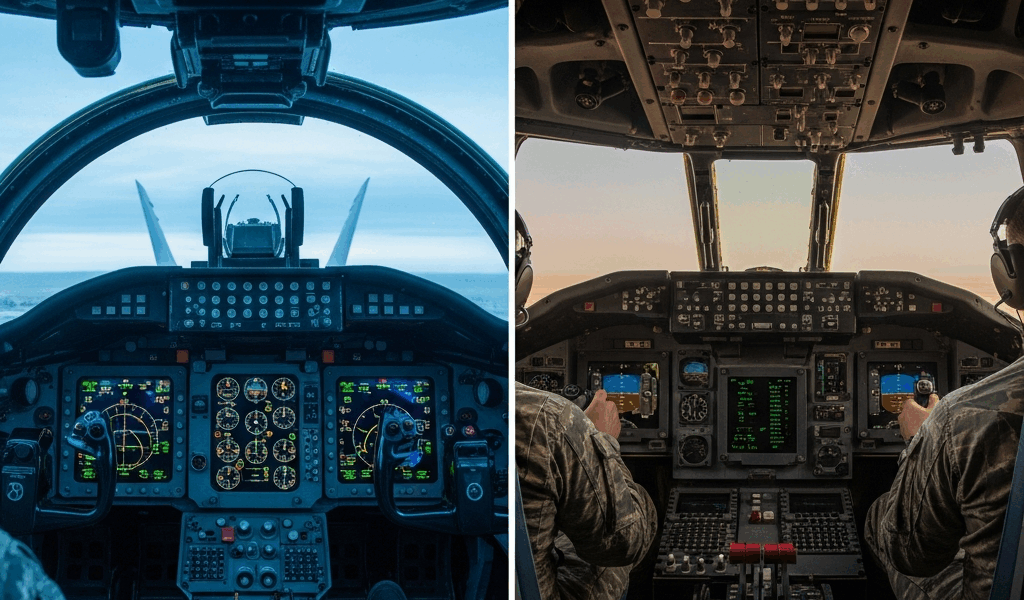
Military Pilot Training Has Gotten Complicated With All the Misinformation Flying Around
As someone who has spent years researching every branch’s aviation pipeline, I learned everything there is to know about military flight training programs. Today, I will share it all with you.
Here’s what most people get wrong immediately: choosing a military pilot training program is not picking a generic pathway. The Air Force calls their program Undergraduate Pilot Training — UPT. The Army runs Warrant Officer Flight Training, known as WOFT, or funnels officers through a separate pipeline entirely. Navy and Marine Corps candidates move through Naval Aviation Schools Command, NASC. These are not interchangeable. Not even close.
But what is military pilot training, really? In essence, it’s a branch-specific selection and instruction system designed to produce combat-ready aviators. But it’s much more than that — it’s a years-long commitment with completely different timelines, washout rates, and aircraft assignments depending on which uniform you put on.
Before we get into each branch, let’s define the terminology you’ll actually encounter:
- UPT — Air Force’s officer pilot training pipeline. Roughly 12 months of intensive flight instruction.
- SUPT — Specialized Undergraduate Pilot Training, the formal name for the enlisted Air Force pilot route. Less common these days.
- WOFT — Army’s pathway to becoming a warrant officer pilot without a commission. Faster and more direct than most people realize.
- API — Aviation Preflight Indoctrination, the Navy’s screening and selection course that comes before any formal flight training begins.
- IFS — Initial Flight Screening, the Air Force’s pre-UPT filter. Conducted at Pueblo, Colorado. Four weeks. Not optional.
Now you’ve got the language down. So, without further ado, let’s dive in.
Air Force Undergraduate Pilot Training
The Air Force pipeline is the longest — and also the most visible. You need a bachelor’s degree and an Officer Training School commission before anything else happens. That’s the gate. No exceptions exist. After commissioning, you wait. That wait stretches anywhere from six months to three years depending on board selection cycles and class availability.
Here’s the realistic timeline. The Air Force Personnel Center board meets quarterly. Get selected, and you report to Initial Flight Screening at Pueblo, Colorado — a four-week washout course running you through the Slingsby T-3A Firefly, a single-engine trainer with a price tag around $2.3 million per aircraft. Roughly 15 to 20 percent of candidates don’t make it through IFS. For the first few flights, you’re sitting in the back seat watching your instructor. Feels pointless. It isn’t — it’s training you to think like a pilot before you actually touch the controls.
Clear IFS and you move to formal UPT at one of four bases: Laughlin AFB in Texas, Columbus AFB in Mississippi, Vance AFB in Oklahoma, or Sheppard AFB in Texas. The full program runs 12 months. Sometimes 14, if weather or checkride failures push your schedule back.
The aircraft progression is fixed. You start on the T-6 Texan II for primary training — about 120 hours logged — then hit a split. Your performance, the Air Force’s service needs, and your PCSM score (Pilot Candidate Selection Method) determine your track.
- Fighter/Attack track — T-38 Talon training, 130-plus hours. Feeds F-35, F-16, and F-15 pipelines.
- Large aircraft track — T-1 Jayhawk training, 130-plus hours. Feeds KC-135 tankers, C-130 transport, strategic airlift assignments.
The PCSM score matters enormously. It combines your AFOQT (Air Force Officer Qualifying Test) score, logged flying hours, and class ranking. Average selected pilots score 75 or above. Anything below 50 is essentially uncompetitive. Log 200-plus civilian flying hours and your PCSM climbs noticeably — which is why some applicants spend $15,000 to $20,000 on civilian flight school before even submitting a package.
Selection rates sit around 10 to 12 percent. You’re competing against roughly 1,500 to 2,000 applicants per board. The boards want your AFOQT score, undergraduate GPA (3.5-plus preferred), physical fitness score (90-plus), and a strong interview.
Don’t make my mistake — I spent months assuming civilian flight hours were a neutral factor. They help. Significantly. Max them out before applying if your budget allows it at all.
Army Flight Training at Fort Novosel
The Army splits immediately into two pathways depending on whether you’re coming in as an officer or enlisted. That distinction changes everything about your timeline.
Warrant Officer Flight Training (WOFT)
Probably should have opened with this section, honestly. WOFT is genuinely less bureaucratic than the officer route, and nobody talks about it because Air Force and Navy pilots generate more publicity.
You don’t need a degree. High school diploma or GED gets you in the door — as long as you’re a current Army soldier or eligible to enlist. The WOFT selection board uses the AFAST (Alternate Flight Aptitude Selection Test) rather than the AFOQT. You’re competing against far fewer candidates — maybe 300 to 400 applicants per fiscal year — with selection rates hovering around 40 to 50 percent. That’s not a typo.
The entire pipeline runs roughly 18 to 24 months from enlistment to wings. No OTS delay. No year-long wait on a quarterly board. You report to Fort Novosel, Alabama, for Phase 1: Basic Combat Training and Warrant Officer Candidate Course, which runs about 12 weeks. Then directly into flight training.
The aircraft emphasis is rotary-wing. Primary training happens in the TH-67 Creek — a Bell 407 derivative — then you move to the UH-60A Black Hawk or AH-64 Apache depending on track selection. Fixed-wing options do exist but are rare, mainly the U-28A Draco for special operations support roles.
For the AFAST, competitive WO candidates score 290 or above. The test skews heavily toward spatial reasoning rather than the broader academic coverage you’d find in the AFOQT. You can retake it once if you score below 225. That’s your only retry.
I’m apparently someone with zero patience for institutional delay, and WOFT works for me while the Air Force’s multi-year waitlist never would. That’s what makes WOFT endearing to us impatient types.
Officer Flight Training Pipeline
Army officers run through standard OCS first, then flight school at Fort Novosel. That adds roughly 12 weeks on top of everything else. The rotary-wing focus stays the same regardless of commissioning source.
Navy and Marine Corps Pilot Training Pipeline
Naval Aviation Schools Command at Naval Air Station Pensacola, Florida oversees both Navy and Marine Corps pilot selection. Single pipeline. Both branches use it.
Selection starts with API — Aviation Preflight Indoctrination — a three-week screening course where about 30 percent of candidates wash out. The flight physical here is more stringent than what Army or Air Force candidates face. Color vision, depth perception, g-force tolerance — all evaluated. Corrected vision worse than 20/40 is disqualifying. Astigmatism limits are tight. These aren’t soft guidelines. They’re hard stops that end candidacies immediately.
The competitive Navy pilot applicant walks in with a 3.6-plus GPA, 1400-plus SAT or 34-plus ACT, ASTB (Aviation Selection Test Battery) subscores of 8/8/7 or better, and documented leadership experience. Selection rates run 8 to 10 percent against roughly 2,000 annual applicants.
Get selected, and you report to VT-86 squadron at Pensacola for primary training. The T-6 Texan II again — about 130 hours. Then the split: jets (T-45 Goshawk), large aircraft (C-130, P-8 Poseidon), or rotary-wing (MH-60 Seahawk, MH-53 Sea Dragon). Jet track is the most competitive cut — only 25 to 30 percent of primary graduates flow into fighter training. Total pipeline from API to wings runs 18 to 24 months.
Marines follow the exact same pipeline, typically ending up in F-35Cs or AV-8B Harriers. Jet assignments run slightly more common for Marine pilots than Navy pilots — but the gap is smaller than recruiting materials usually suggest.
How to Pick the Right Branch for Your Goals
Stop thinking about prestige. Think about three things: aircraft type, timeline, and how much bureaucratic friction you can genuinely tolerate.
If You Want to Fly Fighter Jets
Air Force or Navy. Full stop. The Army doesn’t train fixed-wing fighter pilots — rotary-wing support is their world. The Air Force F-15, F-35, and F-16 pipeline is larger overall. The Navy F/A-18 Super Hornet pipeline is smaller but equally competitive. Both require the officer commission path. Budget three to five years from commission to wings — at least if you want realistic expectations going in.
If You Want to Fly Helicopters
Army WOFT is your fastest route — 18 to 24 months from enlisting to wings. No degree required. No OTS delay sitting between you and the flight line. Navy and Marine Corps helicopter pilots move through the same initial training as fixed-wing candidates before splitting into rotary-wing tracks, making the overall timeline comparable to Air Force pipelines.
If You Want the Shortest Path to the Cockpit
Army WOFT wins. No degree requirement. No officer training school. Roughly 50 percent selection rate. You’re flying 18 months after enlisting. That’s it.
If You Can Wait but Want the Widest Aircraft Options
Air Force UPT. Four training bases, multiple aircraft tracks, strategic airlift and tanker pipelines — post-training assignment variety is genuinely broader here. Navy offers similar breadth but through a smaller pipeline overall.
Be honest with yourself about institutional delay. The Air Force makes you wait — sometimes for years. Army WOFT moves faster because fewer bureaucratic layers exist between selection and flight school. That speed comes with a tradeoff: warrant officers have fewer career branch options later compared to commissioned officers. That’s a real consideration, not a minor footnote.
While you won’t need to master every pipeline detail overnight, you will need a handful of critical resources — AFAST prep materials if WOFT interests you, practice AFOQT tests if you’re Air Force-bound, and waiver documentation guidance if vision correction, age concerns, or prior service questions apply to your situation.
The difference between scoring a 65 and a 75 on these tests changes your selection odds by roughly 30 percent. First, you should start testing yourself under timed conditions — at least if you want an accurate picture of where you actually stand before submitting a package.
AFOQT prep books might be the best option, as Air Force selection requires strong academic subscores. That is because the PCSM formula weights your AFOQT performance heavily alongside flight hours and class rank.
Pick based on the aircraft, not the uniform color. Pick based on timeline tolerance, not which recruiter happened to call you first. And if the longer path gets you into the specific cockpit you actually want — take it.



Leave a Reply