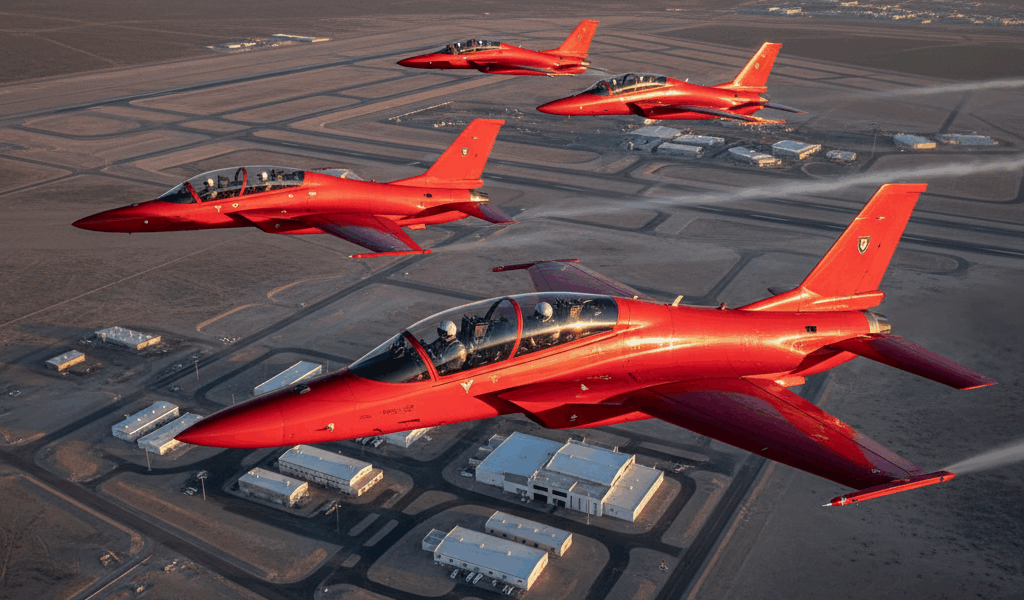
Air Force Expands Advanced Pilot Training Program with New T-7A Simulators
Pilot training has gotten complicated with all the new technologies and methodologies flying around. As someone who’s followed military aviation training evolution for years and talked with instructor pilots about what actually works, I learned everything there is to know about how the Air Force is revolutionizing its approach. Today, I will share it all with you.
The United States Air Force has inaugurated a state-of-the-art T-7A Red Hawk simulator facility at Joint Base San Antonio-Randolph, marking a significant advancement in fighter pilot training methodology. The $180 million facility houses 24 full-motion simulators that will transform how the next generation of combat pilots develops their skills. This is a big deal for the training community.
Probably should have led with this section, honestly. The new simulators feature unprecedented visual fidelity, with wrap-around displays providing 360-degree situational awareness. Each unit can network with others to create complex multi-ship training scenarios without the expense and risk of actual flight operations. That’s what makes this investment so transformative.
“We can now expose student pilots to scenarios that would be too dangerous or expensive to replicate in the air,” explained Colonel Sarah Mitchell, Commander of the 12th Flying Training Wing. “They can practice air-to-air combat, surface-to-air missile evasion, and emergency procedures hundreds of times before ever facing these situations in a real aircraft.” Instructors I’ve spoken with describe this capability as a game-changer for building student confidence.
The T-7A Red Hawk itself represents a revolutionary approach to pilot training. Built with an open architecture software system, the jet can be rapidly updated to simulate adversary tactics and new weapons systems. Boeing and Saab developed the aircraft through a digital engineering process that reduced development time by 80 percent compared to traditional methods. That’s what makes the T-7A program a model for future aircraft development.
Student pilots will complete approximately 40 percent of their training hours in simulators before transitioning to actual T-7A flights. This blended approach is expected to produce combat-ready pilots faster while reducing training costs by an estimated $1.3 billion annually once fully implemented. The cost savings alone justify the investment, but the quality improvements are equally important.
The Air Force plans to establish similar facilities at Columbus AFB, Mississippi, and Vance AFB, Oklahoma, by 2028. The service currently faces a pilot shortage of approximately 1,650 aviators, and the enhanced training capacity is viewed as critical to closing that gap. Every pilot I’ve talked to understands the urgency here.
International partners including Australia and Singapore have expressed interest in the T-7A training system, potentially opening export opportunities for both the aircraft and simulator packages. If foreign sales materialize, it could help drive down per-unit costs for everyone involved.

Leave a Reply