“`html
Do Military Pilots Wear Glasses During Flight
Yes. Military pilots wear corrective lenses during flight operations — and this is probably the first thing you need to know if you’re sitting with a prescription and wondering whether you should even bother applying.
Here’s the distinction that matters: uncorrected vision and corrected vision are measured against completely different standards. The military doesn’t require you to see 20/20 with your naked eyes. They require your best-corrected visual acuity — meaning with glasses or contact lenses in place — to meet operational minimums, typically 20/40 or better in each eye. Sometimes it’s 20/20, depending on the aircraft and mission profile.
Where it gets complicated is the refractive error itself. Your prescription strength — measured in diopters — has hard limits. You can wear glasses to correct your vision. But if your prescription is too strong, you fail the medical screening regardless of how well corrected you become. The Air Force, Navy, and Marines each maintain slightly different thresholds. And these aren’t arbitrary numbers. They’re based on centrifugal stress during high-G maneuvers, spatial disorientation risk, and the biomechanics of prolonged cockpit wear.
Contact lenses? Also allowed, though some branches have restrictions on extended-wear or colored contacts during certain missions. Most candidates use either glasses or contacts interchangeably for the flight physical itself.
Refractive Error Limits by Air Force, Navy, and Marines
I spent six months researching military aviation medical standards, honestly. The variance across branches genuinely caught me off guard. What disqualifies you in one service might be waiverable in another.
Air Force Standards
The Air Force allows myopia (nearsightedness) ranging from -0.5 to -8.0 diopters. Hyperopia (farsightedness) can go from +0.5 to +8.0 diopters. Astigmatism is capped at ±3.0 diopters. If your prescription falls within these ranges and your best-corrected acuity hits 20/40 or better, you’re medically eligible. That’s the baseline before any waiver consideration enters the conversation.
The Air Force also applies what’s called the “manifest refraction” requirement — meaning the eye exam must show your prescription is stable, not fluctuating month to month. They want evidence of at least one prior refraction from your civilian ophthalmologist or optometrist, ideally within the previous 12 months.
Navy Standards
Navy pilot candidates face tighter constraints on myopia: -8.0 diopters is the ceiling, matching the Air Force. Hyperopia maxes out at +8.0 diopters. Astigmatism stays at ±3.0 diopters. Naval aviators must achieve 20/40 best-corrected in each eye, though carrier operations sometimes push for 20/20 due to landing precision demands.
One detail most candidates miss: the Navy requires a cycloplegic refraction — meaning the eye doctor paralyzes your eye’s accommodation muscles with drops to get the truest prescription reading. This prevents your eye from compensating and masking a stronger underlying refractive error. Air Force examiners do this too, though it’s less consistently documented in candidate handbooks.
Marines Standards
Marine pilot thresholds are essentially identical to Navy standards: -8.0 to +8.0 diopters for sphere, ±3.0 for astigmatism. Marines sometimes emphasize the uncorrected acuity requirement more heavily — they want to see 20/200 or better uncorrected in at least one eye, as a secondary gate. This doesn’t disqualify you if you fail that threshold, but it flags you for additional scrutiny during the medical review.
All branches update these standards periodically. The figures I’m citing reflect 2024 policy, but verify with MEPS (Military Entrance Processing Station) before submitting your application. Official standards are published in each branch’s flying class medical instructions — these are public documents available through military medical guidance offices.
What Happens During the Flight Physical Eye Exam
The eye exam isn’t a routine DMV vision check. You’re examined by an ophthalmologist who specializes in aviation medicine, and the process is methodical and specific.
It starts with your visual history. They’ll ask about surgeries, injuries, medications affecting vision, and family history of eye disease. Bring your most recent civilian eye exam records — this matters more than you’d expect. MEPS examiners cross-reference your submitted records against their findings to spot inconsistencies or deterioration.
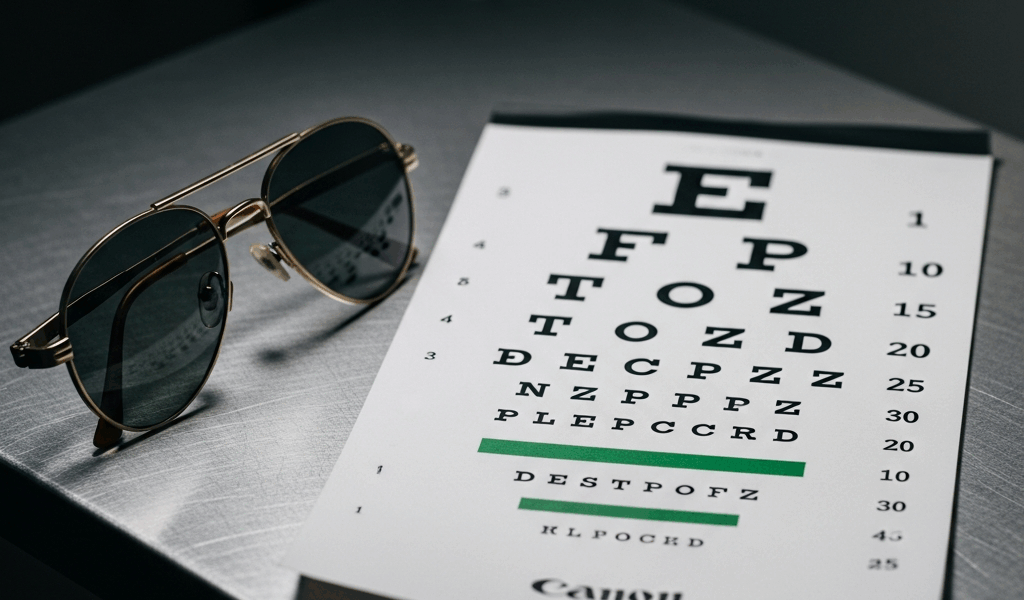
Next comes distance visual acuity testing using a standard Snellen chart. You read the letters at 20 feet with and without correction. Then the manifest refraction — the doctor places different lens combinations in a phoropter and asks which is clearer: “One or two? One or two?” They’re measuring your exact prescription. The cycloplegic refraction follows: dilating drops paralyze your ciliary muscle for 30 to 45 minutes, and they re-measure to confirm the true refraction without your eye compensating.
Intraocular pressure gets checked via tonometry — a puff of air or an applanation tonometer touching your cornea. They’re screening for glaucoma. You’ll undergo slit-lamp examination of your cornea, lens, and anterior chamber. Last comes the dilated fundus examination, where they look at your retina and optic nerve for any signs of disease or structural abnormality.
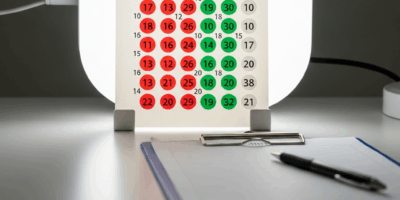
Color vision testing is separate but critical. The Ishihara color plates or similar pseudoisochromatic test screens for color blindness. Red-green color deficiency disqualifies you from most pilot positions, particularly fighters. Some transport or rotary-wing slots may have slightly relaxed standards, but that’s rare.
A “pass” means your best-corrected acuity meets minimums and your refractive error falls within allowable limits. A “fail” means one of those thresholds is exceeded. Your myopia is -8.5 diopters? You’ve exceeded the limit. Your best-corrected acuity is only 20/50 even with correction? You’ve exceeded the acuity minimum. Either one triggers a disqualification letter — though disqualification isn’t automatic rejection of a waiver request.
How to Appeal a Refractive Error Disqualification
Got disqualified on your flight physical? Don’t assume the decision is final. Refractive error waivers are granted regularly — though the military doesn’t publish approval rates.
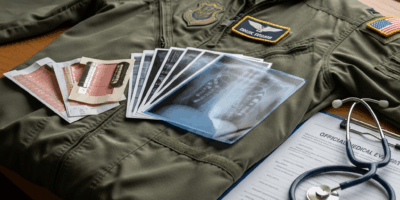
Start by obtaining a complete copy of your flight physical results and the specific reason for disqualification. MEPS must provide this within 30 days of request. You’re looking for the exact measurements: sphere, cylinder, axis values, and the examiner’s comments.
Gather your civilian eye records — every refraction from the past two to three years. Consistency in your prescription strengthens waiver odds. If your prescription has been stable at -8.2 diopters for three years, the waiver officer sees a predictable, well-controlled refractive error rather than a deteriorating or unstable condition.
Request a letter from your civilian ophthalmologist or optometrist addressing the specific military limits. They should write directly to the Military Entrance Processing Station (MEPS) or the branch’s Medical Standards Office, not to you. The letter should include your prescription history, clinical observations about your eye health, and their professional opinion on whether your refractive error poses any safety risk during flight operations. They won’t guarantee approval — they can’t — but medical credibility carries weight.
Submit the waiver package through the appropriate channel. For Air Force, that’s typically the Air Force Medical Standards Office. For Navy or Marines, it’s Naval Aerospace Medical Institute (NAMI). Include the original disqualification letter, your eye records, the ophthalmologist’s letter, a personal statement explaining your commitment to aviation, and any additional supporting documentation.
Timelines vary wildly. Some waivers take 4 to 6 weeks. Others take 6 months. The military doesn’t publish expected processing times for aviation medical waivers, so assume you need to reapply to another selection board cycle if the waiver isn’t approved before your eligibility window closes.
Approval rates aren’t officially disclosed, but anecdotal evidence suggests that waiver approval is realistic if your refractive error is marginally outside limits — say, -8.3 diopters when the limit is -8.0. Egregious cases (like -10 diopters with uncorrectable vision) rarely get approved. Often the deciding factor hinges on whether a flight surgeon determines your specific refractive error creates unacceptable risk in the particular aircraft you’d fly.
LASIK and PRK: Waiver Timelines for Pilot Candidates
Refractive surgery — LASIK, PRK, or SMILE — offers a direct path around diopter limits. But the military doesn’t fast-track post-surgery candidates. There’s a waiting period.
The Air Force requires a minimum of 6 months post-LASIK or PRK before a flight physical can be conducted. Some sources cite up to 12 months, depending on the stability of your correction. Your cornea continues remodeling for weeks after surgery, and prescriptions can shift. The military wants your refraction completely stable before screening.
You must obtain detailed surgical records: pre-operative refraction, intra-operative parameters (ablation depth, optical zone diameter), post-operative refraction at 1 month, 3 months, and 6 months post-op. Your ophthalmologist should document that your refraction is stable — not changing more than 0.5 diopters month-to-month by the 6-month mark.
Navy and Marine timelines are similar: 6 to 12 months post-op, with emphasis on documented stability. The Navy’s official guidance specifies that approved surgeries include standard LASIK and PRK performed at accredited surgical centers. Wavefront-guided and topography-guided procedures are acceptable, though they review the methodology more carefully.
Here’s something I learned researching this — probably should have opened with it, honestly. The military won’t approve waivers for refractive surgery candidates who are *planning* surgery. You must have the surgery, wait the required months, and then apply to the flight physical. The military doesn’t grant provisional approval or expedited processing for candidates recovering from surgery. You’re back in the standard applicant queue, medically speaking.
If your post-operative refraction is better than 20/20 and falls within diopter limits, your medical eligibility is essentially identical to any other candidate. The surgery records are reviewed, but they don’t trigger additional scrutiny once stability is confirmed and you’re within limits.
“`


Leave a Reply