Military Pilot Vision Requirements — Can You Fly
Military pilot vision requirements have gotten complicated with all the outdated manuals, dead forum threads, and recycled misinformation flying around. As someone who nearly torpedoed their Navy OCS application over a –2.75 prescription in my left eye, I learned everything there is to know about what actually disqualifies you versus what just sends you into waiver territory. Junior year of college, about three weeks before I hit submit on my application — that’s when I realized I had no idea where I actually stood. What I found online was genuinely useless. Air Force PDFs from 2011, Army forums where nobody cited a single regulation, Reddit threads full of confident strangers guessing. So I dug into the actual standards, called a flight surgeon, and eventually assembled a picture that should have taken me forty minutes to find. This is that reference, current for 2026, covering all three major branches.
Vision Standards by Branch — 2026
Each branch runs its own flight class system — and those classes map to specific cockpit roles. They’re not interchangeable terms, and treating them like they are will waste your time.
Air Force Flight Classes
The Air Force uses three flight classifications. FC I is for pilots — the tightest standards of any branch. FC II covers navigators, combat systems officers, and air battle managers. FC III handles remotely piloted aircraft operators and controllers, a category that expanded considerably after 2010.
But what is the FC I refractive standard, exactly? In essence, it’s a window of –1.50 to +1.50 diopters spherical equivalent, with no more than 1.50 diopters of astigmatism. But it’s much more than that — it’s the requirement that catches people who assume “correctable to 20/20” is the whole story. Your glasses could bring your vision to perfect and you’d still wash out on the raw diopter number alone. Uncorrected distant visual acuity must hit 20/70 or better in each eye, correctable to 20/20. Near vision must be 20/20 correctable.
FC III is a different world — uncorrected acuity of 20/400 correctable to 20/20, and a refractive window that opens all the way to –8.00/+6.00. Flying a Predator instead of an F-35 means a genuinely different path through the medical pipeline.
Navy and Marine Corps Standards
Navy aviation uses Class I and Class II designations. Class I covers student naval aviators and pilots of high-performance aircraft — uncorrected distant visual acuity of 20/40 or better in each eye, correctable to 20/20. The refractive error window sits at –8.00 to +8.00 diopters spherical equivalent. That’s substantially more permissive than Air Force FC I on the myopia side, which surprised me when I first read it.
That’s what makes the Navy standard endearing to us nearsighted candidates — the raw prescription tolerance is genuinely more forgiving for primary pilot classification. The tradeoff is that the Navy’s color vision and depth perception protocols are among the most demanding in any service. More on that shortly.
Army Aviation Standards
Army aviation operates under AR 40-501 using Class 1, Class 2, and Class 3 designations. Class 1 covers Army aviators — rotary wing and fixed wing both. Uncorrected distant visual acuity must be 20/50 or better in each eye, correctable to 20/20. Refractive error limits run –6.00 to +3.00 diopters. The Army also tests near and intermediate vision specifically because helicopter operations put instrument panels at arm’s length for extended periods. That’s not a detail other branches emphasize as heavily.
| Branch / Class | Uncorrected Acuity (each eye) | Corrected Acuity | Refractive Error Window |
|---|---|---|---|
| Air Force FC I | 20/70 | 20/20 | –1.50 to +1.50 D |
| Air Force FC II | 20/200 | 20/20 | –3.00 to +3.00 D |
| Air Force FC III | 20/400 | 20/20 | –8.00 to +6.00 D |
| Navy Class I | 20/40 | 20/20 | –8.00 to +8.00 D |
| Navy Class II | 20/200 | 20/20 | –8.00 to +8.00 D |
| Army Class 1 | 20/50 | 20/20 | –6.00 to +3.00 D |
These numbers are the baseline qualifying standard — not the final word. Waivers exist, and they get approved more often than most applicants expect going in.
PRK and LASIK — Are You Cleared to Fly
Probably should have opened with this section, honestly, because it’s what most people searching this topic actually need. Refractive surgery reshaped military pilot eligibility over the past fifteen years — the rules are now fairly well-defined, with some critical branch-by-branch wrinkles that matter enormously depending on where you’re applying.
Which Procedures Are Approved
PRK — photorefractive keratectomy — is approved by all three major branches for pilot candidates. LASIK is more complicated. The Air Force and Navy allow LASIK across many flight class categories, but PRK remains the preferred procedure because it leaves more corneal tissue intact and carries better long-term stability data under high-G and high-altitude conditions. LASEK and SMILE are generally not approved without a specific waiver. Epi-LASIK sits in a similar gray zone — don’t assume it’ll slide through.
Frustrated by a –3.50 prescription that put me outside Navy refractive limits, I got PRK done at a clinic in San Diego on a WaveLight EX500 laser — the same platform many military medical centers use. Out-of-pocket cost at a civilian clinic ran about $4,200 for both eyes in 2023. Some military medical centers perform PRK at no cost for active duty members, but the waiting lists run long. Plan accordingly.
Wait Times After Surgery by Branch
This is where people get tripped up. Clearing the procedure approval question is only step one.
- Air Force FC I: Minimum one year post-PRK before applying. Stable refraction required for six months at the time of examination.
- Navy Class I: Six months post-PRK for initial application, with documentation of refractive stability. LASIK requires the same six-month minimum.
- Army Class 1: Six months post-PRK. Army also requires pre-operative records going back at least one year — a detail that catches people who got surgery and immediately tried to enlist without pulling their old charts first.
Stable refraction means less than 0.50 diopters of change between two consecutive measurements taken at least three months apart. Get those records from your surgeon before you need them. Don’t make my mistake — I spent three weeks tracking down a pre-operative refraction from a clinic that had switched EMR systems and nearly lost the file entirely.
The Waiver Process for Surgery
If your procedure type or wait period creates a disqualifying finding, a waiver is available through the same process covered at the end of this article. Surgery-related waivers carry a relatively high approval rate — the outcome data is mature, the procedures are well-understood, and flight surgeons aren’t guessing at the risk profile anymore.
Color Vision and Depth Perception Tests
Here’s where candidates with otherwise clean vision get screened out — and where the branch differences probably matter more than anywhere else in this process.
The Tests You Will Actually Face
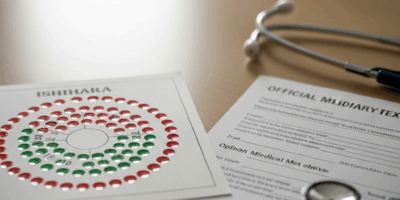
Three color vision assessments show up across military aviation: the pseudoisochromatic plate test (PIP — essentially the Ishihara plates most people have seen), the Farnsworth D-15 arrangement test, and the FALANT — the Farnsworth Lantern Test. They measure different things and carry different weight depending on which branch is evaluating you.
The PIP is a screening tool. Fail it and you aren’t automatically disqualified — you move to confirmatory testing. The D-15 uses fifteen colored caps arranged by hue. The FALANT presents pairs of colored lights across nine combinations of red, white, and green — it was developed specifically for navigation tasks and is the standard most directly tied to actual cockpit requirements. That’s the one that matters most.
What Failures Mean
Failing the Ishihara plates alone — but passing the FALANT — is waiverable in the Navy and Army. The Air Force is more restrictive. FC I requires passing the FALANT specifically, and some mild color deficiencies that clear Navy standards will still disqualify an Air Force FC I candidate. Failing the D-15 significantly, or failing the FALANT outright, is typically disqualifying for primary pilot roles without a waiver.
Depth perception testing uses the Verhoeff Stereopter or the Howard-Dolman apparatus — both assess relative depth detection at near and far distances. Mild stereoacuity deficiencies can sometimes be waivered for multi-crew or rotary wing roles, where the depth requirement differs from single-seat high-performance aircraft.
The Waiver Process — It Is Not Automatic
Dragged through three separate medical holds during my own application, I can tell you — a waiver request is an argument, not a form. You’re building a case for why your specific condition doesn’t create unacceptable operational risk. Treat it like that from the start.
How to Submit
The process begins at the Military Entrance Processing Station (MEPS) or the branch-specific aviation medicine clinic, depending on where you are in the pipeline. A disqualifying finding generates a medical hold. From there — you gather documentation. Surgical records, civilian ophthalmology exams using the Humphrey Field Analyzer if visual field issues are on the table, refractive stability records — everything goes through your recruiter or officer selection officer to the appropriate waiver authority.
Air Force waiver authority for pilot vision issues sits with the Aeromedical Consultation Service at Wright-Patterson AFB in Ohio. Navy waivers run through the Naval Aerospace Medical Institute in Pensacola, Florida. Army waivers go through the Aeromedical Activity at Fort Novosel — formerly Fort Rucker — in Alabama.
Timeline and Success Rates
Timelines are real. Budget six to twelve weeks for a routine vision waiver if your documentation is complete. Incomplete packages get returned — the clock resets entirely. That missing pre-operative refraction record I mentioned earlier set me back three weeks on my own package. Pull everything before you submit.
Success rates vary by condition. PRK waivers for candidates who otherwise meet standards run above 80 percent approval historically. Color vision waivers for mild deficiencies that pass the FALANT land in similar territory. Waivers for significant refractive errors outside corrected-acuity standards — or for failed FALANT results — drop considerably, somewhere in the 20 to 40 percent range depending on role and branch.
Apply anyway if the condition is waiverable. The worst documented answer is still more useful than an assumption that you can’t fly.

Leave a Reply